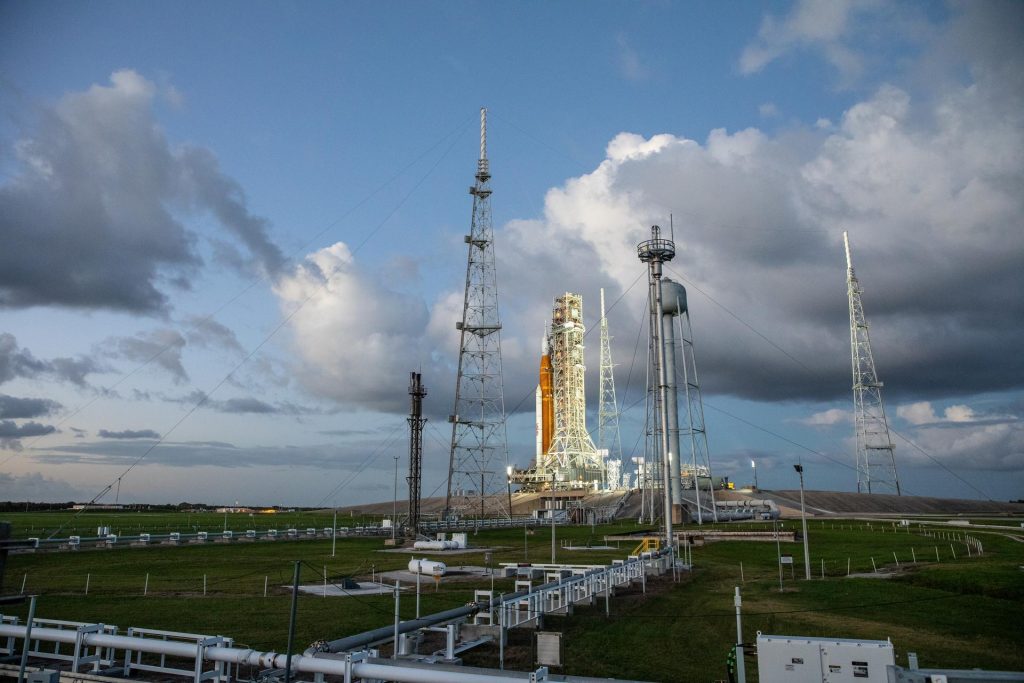
ASHEBORO N.C. (ACME NEWS) —For the first time in more than 50 years, astronauts are set to leave low earth orbit and fly around the Moon.
NASA is preparing to launch four astronauts on a journey around the Moon — farther from Earth than any human has traveled since Apollo 13 in 1970. The mission, called Artemis II, is scheduled to launch on April 1, 2026 from the Kennedy Space Center in Cape Canaveral, and marks a major milestone in America’s return to deep space exploration after decades in low-earth orbit.
Meet the Crew
The four-person crew includes three NASA astronauts and one from the Canadian Space Agency.
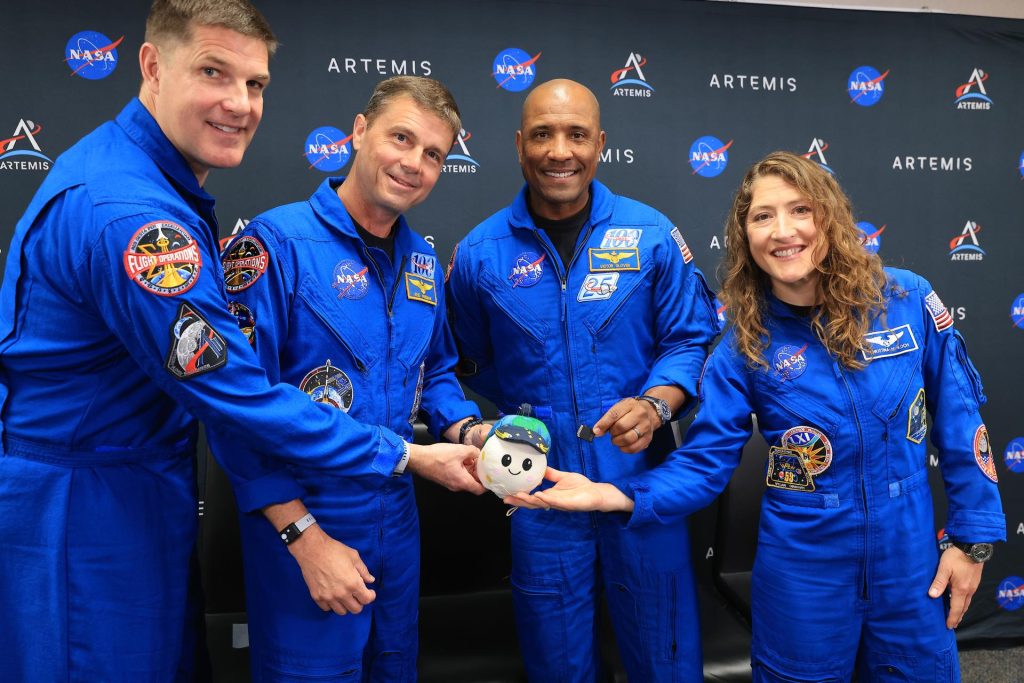
Commander Reid Wiseman, a Baltimore native and veteran of the International Space Station, will lead the mission. Pilot Victor Glover, a California-born naval aviator and test pilot, previously flew to the Space Station in 2020. Mission specialist Christina Koch holds the record for the longest single spaceflight by a woman — 328 consecutive days in orbit — and participated in the first all-female spacewalks. Rounding out the crew is Canadian astronaut Jeremy Hansen, who will become the first Canadian to fly around the Moon.
What Are They Actually Doing?
Artemis II will be a crewed test flight, not a Moon landing; closer to Apollo 8. The crew will launch aboard NASA’s Orion spacecraft, riding atop the massive Space Launch System (SLS) rocket — the most powerful rocket NASA has ever built, producing over 8.8 million pounds of thrust at liftoff.
The SLS uses upgraded versions of the same engines and solid rocket boosters that powered the Space Shuttle for 30 years, combined with a powerful new central core stage.
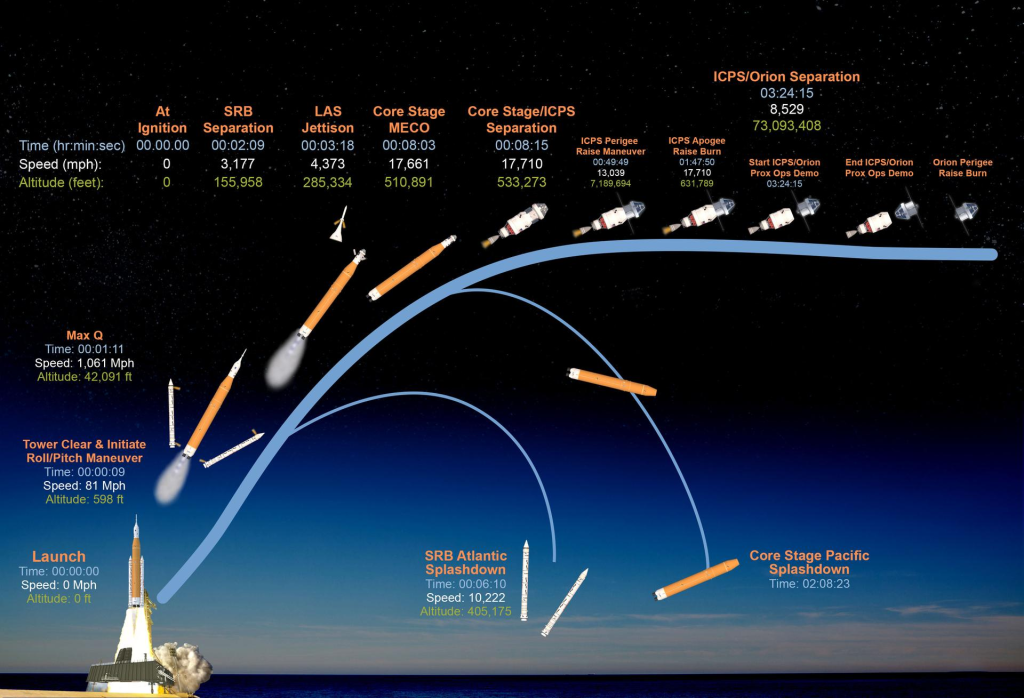
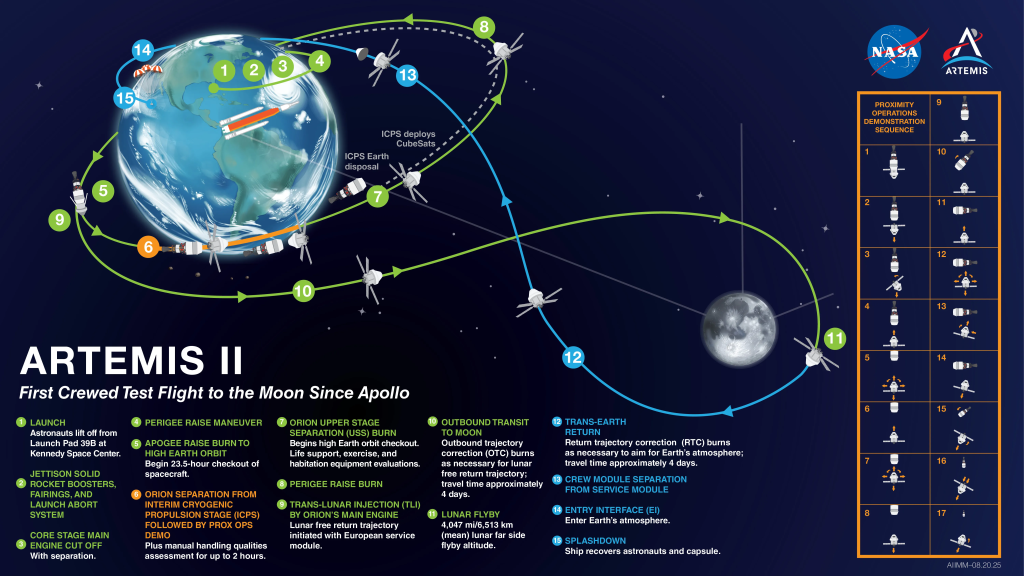
After launch, the crew will spend time in high Earth orbit making sure all of Orion’s systems are working, testing the life support systems that generate breathable air, communications equipment, and practice manual piloting maneuvers. Then, on the second day of the mission, Orion’s engine will fire to send them on a four-day journey toward the Moon.
The crew won’t land — instead, they’ll swing around the far side of the Moon, coming as close as 4,000 to 6,000 miles above the lunar surface. At that point, they’ll briefly lose all contact with Earth for up to 50 minutes as they pass behind the Moon. During that time, they’ll photograph the lunar far side, a view that no human eyes have seen up close in over half a century.
From their vantage point, the Moon will look roughly the size of a basketball held at arm’s length, with the Earth — nearly 250,000 miles away — visible in the background.
After swinging around the Moon, the spacecraft will use the natural pull of Earth’s gravity to make the return trip home without needing to fire its engines — a fuel-saving technique called a free-return trajectory. The whole mission is scheduled to last about 10 days.
How Do They Get Home?
After their swing around the moon and trip back home, the crew module will separate from the rest of the spacecraft and re-enter Earth’s atmosphere. During re-entry, temperatures around the spacecraft can reach roughly 3,000 degrees Fahrenheit. A heat shield protects the crew, followed by a series of parachutes that slow the capsule from about 300 mph to just 17 mph before it hits the water. The crew will land in the Pacific Ocean and be recovered by the U.S. Navy.
Why Does This Matter?
Artemis II is the critical stepping stone to Artemis III — the mission that will actually land astronauts on the Moon’s surface, including the first woman and first person of color to do so. Everything the Artemis II crew learns about how Orion performs in deep space will directly shape the safety and success of that landing mission and future missions beyond.
NASA also has its eye on an even more distant horizon: Mars. The technologies and experience gained from Artemis are designed to build the foundation for eventual crewed missions to the red planet.
For now, though, four astronauts are about to do something no human has done since 1972 — leave the safety of Earth’s neighborhood and venture to the Moon. And this time, they won’t be the last.
The Artemis II launch window opens no later than April 2026. Follow the mission at nasa.gov/artemis.
###