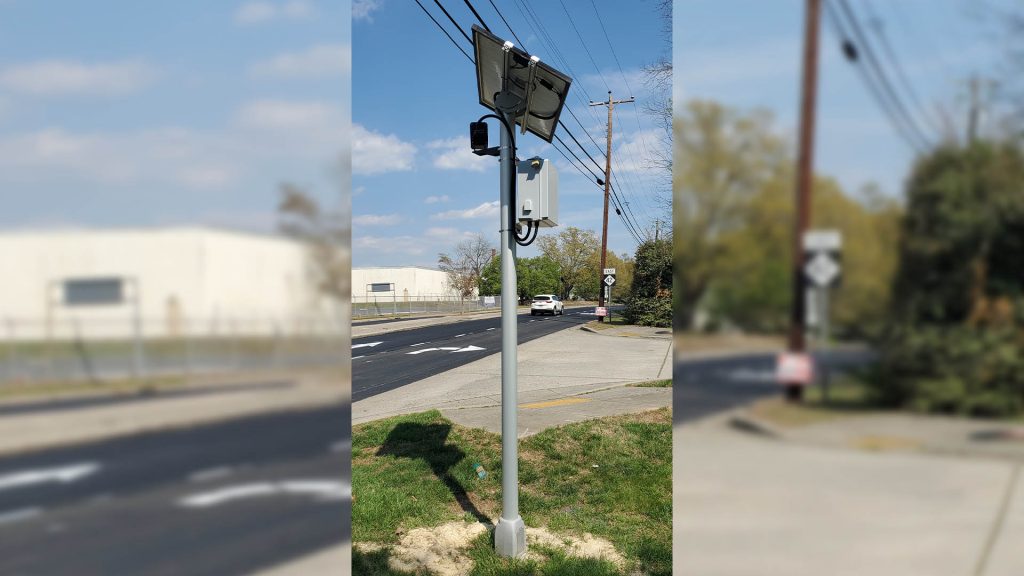
ASHEBORO, N.C. (ACME NEWS) — Since mid-February, Asheboro police have installed eight cameras that photograph every passing vehicle around the clock and share that data with a federal network searchable by hundreds of agencies nationwide.
Police say the cameras, known as automated license plate readers, or ALPRs, are a proven investigative tool that have helped clear cases. Privacy advocates say they amount to a warrantless dragnet with no meaningful oversight.
The cameras were purchased from ELSAG, the U.S. brand name of Italian defense and security contractor Leonardo, at a cost of $9,480 each, with annual warranty and maintenance running about $500 per camera. Six are mounted on poles at private properties — including four churches — and two are at city-owned sites. All eight were fully operational by the end of March, according to Assistant Chief of Asheboro Police Jay Hanson.
Each time a vehicle passes one of the cameras, the system captures a photo of the rear of the vehicle along with the plate number, make, model, color, location, date and time. That data is automatically checked against what the department calls a “hot list” — a database compiled from federal law enforcement records including stolen vehicles and plates, wanted persons, missing and endangered persons, domestic violence protection orders, and a federal gang and terrorist organization file. The list also includes federal immigration violators.
If a plate matches, officers receive an alert; and that is a valuable tool for police that has in the past helped to locate stolen vehicles, track down wanted and missing persons, and even develop suspects or rule out suspects in crimes.
While Asheboro Police declined to comment on or provide specific examples of ALPRs being used locally, we know the department used data from Flock cameras to track down a vehicle connected to the 2024 fatal armed robbery at 64 Skillz in Asheboro, eventually leading to three arrests.
Data Sharing
When a vehicle passes one of Asheboro’s fixed cameras, regardless of if there is a match or not, the data doesn’t stay in Asheboro. It’s uploaded to a server maintained by the Atlanta-Carolinas High Intensity Drug Trafficking Area, or HIDTA — a federally funded law enforcement network — where it becomes accessible to any agency that has signed the network’s data-sharing agreement, and retained for up to 90 days under North Carolina law..
“Any local, state, or federal law enforcement agency can have access to the data with an approved MOU,” APD confirmed in writing. That includes federal agencies like the DEA and Homeland Security Investigations, both of which APD confirmed could search all ALPR data stored on its behalf.
The data sharing agreement does establish guardrails. Access is limited to authorized users who can demonstrate a “need to know” and “right to know,” and agencies must log a legitimate law enforcement purpose before querying the data, along with an incident or report number and the requesting officer’s name and contact information. An audit log records who accessed the data and when. Under the agreement, APD remains the legal custodian of its own data and is responsible for ensuring it is handled in accordance with state law.
The Atlanta-Carolinas HIDTA region alone includes more than 120 participating agencies across Georgia, North Carolina and South Carolina. Federal agencies with potential access include the DEA, FBI, ATF, Customs and Border Protection and Homeland Security Investigations. State and local agencies include the N.C. State Bureau of Investigation, the N.C. National Guard, and departments ranging from Charlotte-Mecklenburg to the Randolph County Sheriff’s Office.
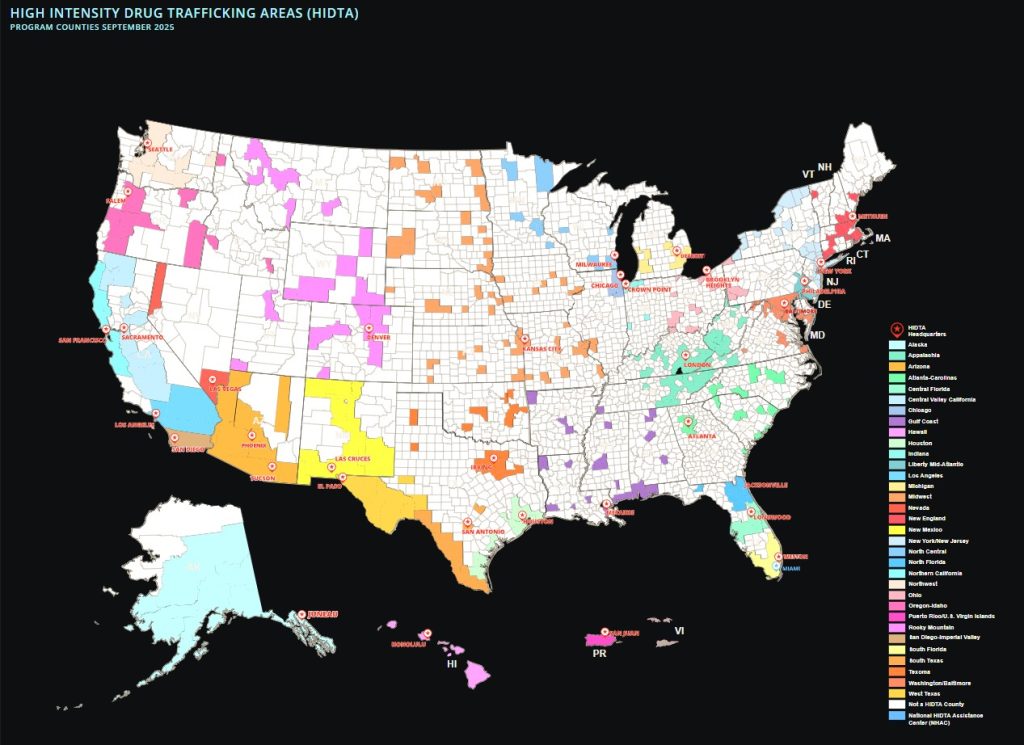
Access is not limited to the region. APD confirmed the network extends to all HIDTA regions nationwide. According to 2022 program data, approximately 3,500 federal, state, local and tribal agencies participate in HIDTA initiatives across 28 regions. How many have active agreements that would allow them to query Asheboro’s camera data is not publicly known.
‘A warrantless digital dragnet’
Adam Schwartz, privacy litigation director at the Electronic Frontier Foundation, said systems like Asheboro’s raise serious civil liberties concerns that go far beyond their stated purpose.
“ALPRs are a vast, warrantless digital dragnet collecting data that can paint an intimate portrait of a driver’s life and even chill First Amendment protected activity,” Schwartz said. “Technology that was sold as a way to ‘catch killers’ can be used to target drivers who visit sensitive places such as health centers, immigration clinics, gun shops, union halls, protests, or houses of worship.” Four of Asheboro’s eight cameras are mounted on church property.
Schwartz said the federal reach of the arrangement makes those concerns significantly worse. “It’s bad enough that police agencies are conducting this warrantless mass surveillance, but they have even less control over the data when it’s shared with other agencies that may be pursuing political agendas with no regard for local and state laws.”
Those concerns are not hypothetical. Officers across the country have faced criminal charges for misusing license plate reader access, citizens have been wrongly accused based on automated camera data, and abuses of the system have been documented by journalist and privacy advocate groups.
In February 2026 — the same month APD began installing its cameras — Milwaukee Police Officer Josue Ayala was charged with misconduct in public office after investigators found he had used his department’s license plate reader system to search the plates of someone he was dating and their ex-partner 179 times over two months while on duty, logging each search as “investigation.” He resigned as part of a negotiated agreement with prosecutors and pleaded not guilty.
In a separate case, Chrisanna Elser of Denver received a criminal summons in September 2025 for package theft after Columbine Valley, Colorado, police used automated camera data to place her vehicle in the area. An officer told her the data was “100 percent” proof of her involvement and refused to review her dashcam footage.
Elser compiled the footage herself — along with GPS records — and the summons was voided three weeks later. Civil rights attorneys criticized the department for requiring Elser to prove her innocence rather than building a case against her.
Police in Lenexa, Kansas, used automated license plate reader technology to pursue a man who wrote a critical op-ed about the department, according to reporting by Kansas Public Radio station KCUR. The American Civil Liberties Union called the case a rare public example of the kind of abuse civil liberties groups have long warned about with mass-surveillance systems.
The ACLU also stated that incident came amid broader concerns about misuse of license plate databases, including reports that U.S. Immigration and Customs Enforcement agents in Minnesota have used such data not for legitimate law enforcement purposes, but to intimidate observers and protesters.
Assistant Chief Hanson said he believed the department’s written policy was sufficient. “I think you’ll find that it is pretty comprehensive and covers most everything,” he wrote. He declined to comment on misuse cases from other jurisdictions, saying the department has “protocols in place to address any improper activity by one of our personnel.”
Asheboro’s policy, last revised in March 2025, requires that data be accessed and used only for “official and legitimate law enforcement purposes” and that any sharing with outside agencies be made only upon a formal written request. Annual audits by the department’s Professional Standards Division are mandated to verify compliance, review access logs and confirm that no data has been retained beyond the authorized 90-day limit.
Schwartz said stronger safeguards could reduce the potential for abuse. “Sensible retention limits, specific policies about who inside an agency is allowed to access data, and audit and control processes could help minimize the potential for abuse. One of the better privacy protections would be for police to retain no information at all when a passing vehicle does not match a hot list.”
Schwartz added: “It’s not at all clear that ALPRs do anything to reduce crime. No jurisdiction should install ALPRs without robust public debate with community input.” APD did not comment on if there was any public input that preceded installation of the license plate cameras.
###