

Deployment Locations Map
The map below contains all the deployment locations for ALPRs in Randolph County N.C. The locations and information about each was obtained through public records request with local law enforcement agencies. Click on a specific camera for more information.
ALPR DETAIL KEY
- Installed – The approximate date the ALPR was installed
- Agency – The law enforcement agency that is connected to the camera
- Location Type – A short description of the type of location the camera was placed on (private or public)
- Partner – The company, organization, or government agency that partnered with law enforcement to allow deployment at the location
- Manufacture – Who makes the ALPR and the model or type of camera
Map note: Locations shown represent known ALPR deployment sites in Randolph County, N.C.. Data sources include law enforcement records, public records requests, and investigative reporting. If you know of a camera we missed, or have information about a camera that is marked as information incomplete, send an email to the news-desk and let us know.
Map not working? Click here to visit on Google Maps in a new tab.
ALPR Questions & Answers
How do automated license plate readers (ALPRs) work?
Automated License Plate Readers (ALPRs) are high-speed digital cameras that capture images of vehicle license plates. These systems use optical character recognition (OCR) software to read the plates and extract data like the plate number, vehicle make/model, location, date, and time. That data is then stored in databases and can be cross-referenced to identify vehicles and track their movements over time.
Law enforcement agencies typically mount ALPRs on police vehicles, fixed locations (like traffic lights or highway overpasses), or portable trailers. A single ALPR can photograph hundreds of plates per minute, meaning data collection happens at massive scale with minimal human oversight.
What data do ALPRs collect and store?
Direct data captured:
- License plate number
- Date and time of capture
- Location of the camera
- Vehicle color, make, and model
- Vehicle damage, stickers, or decals
- Photo of vehicle and surrounding area
Secondary data created: By tracking the same plate over multiple locations and times, ALPRs create movement profiles—detailed records of where a person drove, when they drove there, and how often they visited specific locations.
This data can reveal sensitive information about a person’s habits, religious practices, political affiliations, medical visits, and more.
While not currently in use locally, some newer ALPRs also capture electronic signals like those from wifi devices such as cell phones and your car’s wifi network, and bluetooth devices like smartwatches, AirTags, and more.
How long is ALPR data kept?
North Carolina law establishes a 90-day default retention period for ALPR data. After 90 days, the data must be destroyed unless a preservation request is filed under a search warrant, in which case retention can be extended for up to one year from the initial preservation request.
In our state, law enforcement agencies must adopt written policies governing retention before deploying ALPRs. Data obtained by a law enforcement agency may only be preserved for law enforcement purposes.
What are the privacy concerns?
Mass surveillance: ALPRs capture and store data on innocent people—not just those suspected of crimes. Everyone’s movements are recorded simply because they drive a vehicle.
No warrant requirement: In most jurisdictions, law enforcement doesn’t need a warrant to deploy ALPRs or access collected data, raising Fourth Amendment concerns about unreasonable searches.
Mission creep: Data collected for criminal investigations can be repurposed for political surveillance, tracking of protesters, or monitoring of activists and journalists.
Bias and accuracy: ALPRs can misread plates, leading to false matches. Combined with biased deployment patterns, this creates heightened risks for certain communities.
Data breaches: The centralized storage of millions of plate reads creates a vulnerable target for hackers and a goldmine for data brokers.
Who has access to ALPR data?
When a vehicle passes one of the ALPRs in Randolph County, the data is uploaded to a server maintained by the Atlanta-Carolinas High Intensity Drug Trafficking Area (HIDTA)—a federally funded law enforcement network. It becomes accessible to any agency that has signed the network’s data-sharing agreement.
The local HIDTA region includes more than 120 participating agencies across Georgia, North Carolina, and South Carolina, including federal agencies like the DEA, FBI, ATF, Customs and Border Protection, and Homeland Security Investigations. Access extends to all HIDTA regions nationwide, with approximately 3,500 federal, state, local, and tribal agencies participating across 28 regions.
While the data-sharing agreement requires authorized users to demonstrate a “need to know” and “right to know,” and access must be logged with a legitimate law enforcement purpose, how many agencies nationwide have active agreements allowing them to query Randolph County’s camera data is not publicly known.
What can I do to protect my privacy?
Know your rights: North Carolina law exempts ALPR data from public records, and you cannot request data about your own vehicle. However, understanding where ALPRs are deployed in your community is the first step toward informed advocacy for privacy protections.
Advocacy: Support organizations and civil liberties groups pushing for stronger ALPR safeguards, such as warrant requirements before data access and stricter limitations on data sharing. Contact your elected officials to voice your concerns about surveillance and privacy.
Transparency: Journalists and civil liberties organizations continue to investigate and document ALPR deployment and use. Staying informed about your community’s surveillance infrastructure is essential for democratic participation in policy decisions.
What is North Carolina’s legal framework for ALPRs?
North Carolina has comprehensive ALPR legislation in Article 3D of Chapter 20 of the General Statutes (G.S. 20-183.30 – 20-183.32A), which establishes:
- A 90-day default data retention period, with extension only through preservation requests or search warrants
- Requirements that law enforcement agencies adopt written policies before deploying ALPRs, addressing databases used, access restrictions, auditing, reporting, and other use guidelines
- Restrictions limiting data access to criminal justice purposes only
- A Class 1 misdemeanor for unlawful access, preservation, or disclosure of ALPR data
However, enforcement and implementation vary across jurisdictions. Civil liberties organizations continue to advocate for additional protections, including warrant requirements before accessing or sharing ALPR data.
What is a hotlist?
A “hotlist” is a database of license plates or known vehicles that law enforcement has added due to their connection to either a missing persons or criminal case, or vehicles that have been reported stolen.
If a vehicle on the hotlist passes an ALPR camera, an alert is sent to the agency in order to help them track that vehicle down. This is the main selling feature of ALPRs and has saved lives. However, even when a vehicle is not a match to the hotlist, the photo and all the data about that vehicle is still uploaded to the server to be stored.
Our reporting on ALPRS
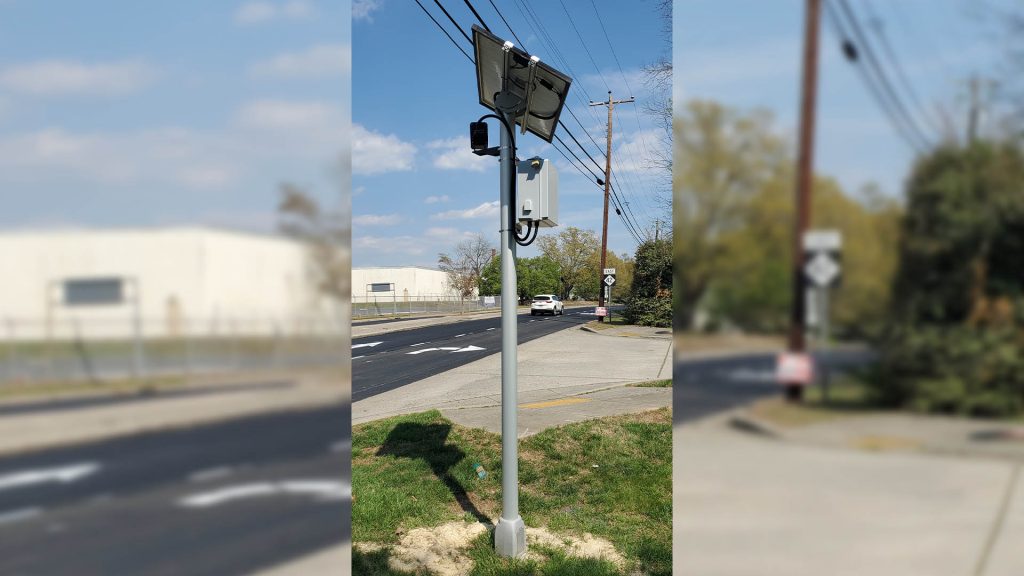
Asheboro’s new license plate cameras feed into federal network; privacy advocates raise concerns
How automated license plate readers deployed by the Asheboro Police Department connect to federal surveillance systems, and what civil liberties organizations say about the privacy implications.
About this page: Acme News is committed to covering government surveillance technologies and their impact on privacy and civil liberties in Randolph County and North Carolina. This page serves as a resource for understanding ALPRs, tracking our investigative coverage, and providing the public with information they need to participate in debates about surveillance policy. Have information about ALPRs in Randolph County? Contact us.