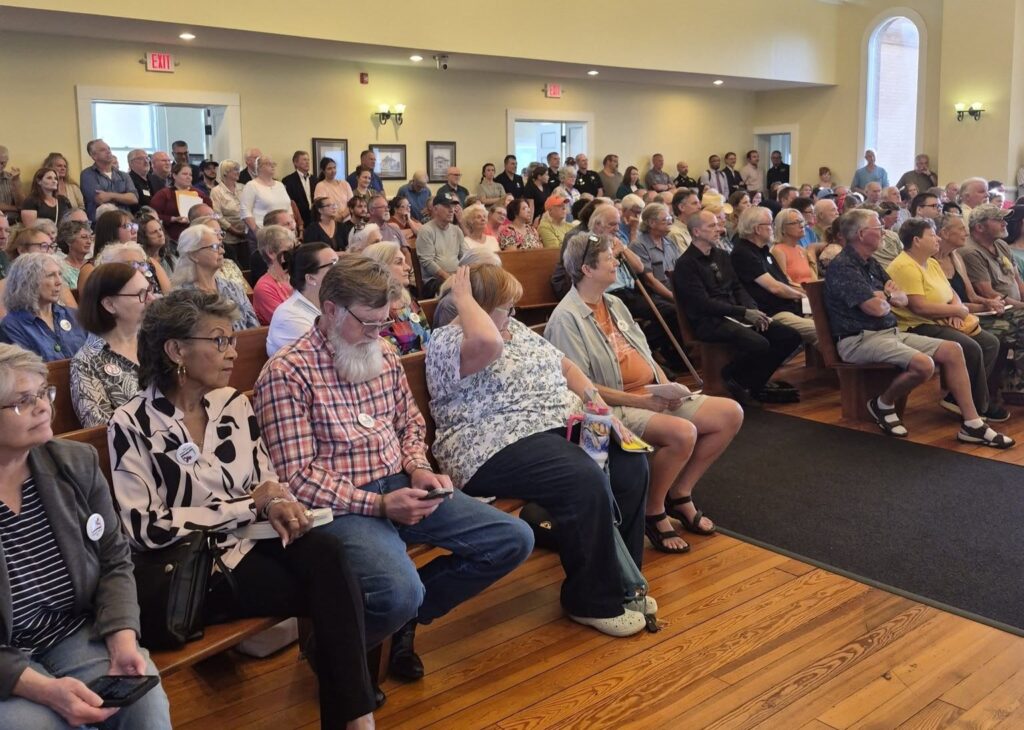
ASHEBORO N.C. (ACME NEWS) — Randolph County commissioners unanimously adopted new data center restrictions Monday after a nearly three-hour hearing packed with residents — most opposed to any data centers in the county.
A Facebook post from Commissioner Lester Rivenbark on July 31, telling citizens “this is your time to be heard on the matter,” combined with neighboring Chatham County’s ongoing legal fight over a moratorium and national attention on data center development, brought a standing-room crowd to the board’s regular monthly meeting at the historic 1901 courthouse in Asheboro Monday night.
No data center has applied to build in the county, commissioners repeated throughout the meeting. Data centers first entered the county’s zoning code in April 2024, as part of a routine update bringing the UDO into compliance with state legislative changes — not in response to any specific request or application.
Around three hours after the meeting started, following more than 30 public speakers, commissioners approved a package of updates to the UDO. Most were required by state law, but the package also included new, county-specific requirements —such as adding a last-minute provision requiring any future data center application to go through conditional zoning; guaranteeing a public hearing before the Board of Commissioners regardless of how the property is already zoned.
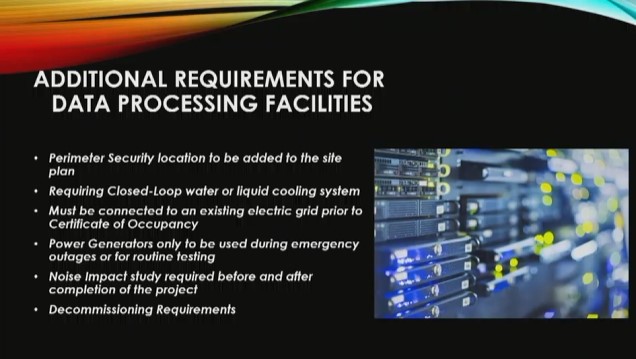
Under the newly adopted changes to the development ordinance, any future data center in Randolph County would be required to:
– Conduct a 1,000-foot impact study radius around any outdoor equipment, requiring the applicant to identify and assess impacts on schools, daycares, hospitals, churches, youth camps, public parks, community centers and existing homes within that distance. That’s double the 500-foot radius under a pending state bill, Senate Bill 730, that would set statewide standards for data centers.
– Applicants must commission a pre-construction sound study — sealed by a licensed acoustic engineer — establishing baseline ambient noise, including narrow-band frequency and tonal analysis. Post-construction noise at the property line can’t exceed that pre-construction baseline, or 60 decibels (roughly the level of normal conversation), whichever is greater.
– Closed-loop water or liquid cooling, certified by a professional engineer, with required disclosure of estimated daily water usage and water source.
– Generator restrictions — on-site generators may be used only for emergency power during outages, or for routine testing capped at four hours per month — as well as a requirement to connect to the existing electric grid before a final Certificate of Occupancy is issued.
– A decommissioning requirement. A facility that ceases operations for 12 consecutive months is considered abandoned unless the owner shows evidence of intent to resume. Applicants must post financial assurance — a bond, letter of credit, or FDIC-insured escrow — covering the estimated cost of decommissioning plus a 10% contingency, reviewed and resubmitted every five years by a licensed engineer.
– Conditional zoning required for all applications — the provision added by commissioners during Monday’s meeting, ensuring any future data center rezoning request comes before the Board of Commissioners for a public hearing, rather than being handled as a special use permit, which would send any appeal directly to Superior Court and bypass the board entirely.
Almost Two and a Half Hours of Public Comments
The ordinance changes were the outcome. Getting there took nearly two and a half hours of public comment, as more than 30 residents lined up to speak — the overwhelming majority opposed to data centers coming to Randolph County under any circumstances, regardless of what restrictions the county put in place.
Water was the most consistent theme. Several speakers questioned whether “closed loop” cooling systems are really closed. Micah Day, of Randleman, raised concerns about local water quality: “The Randleman Nature Trail at Deep River is, as of right now, considered legally unswimmable” due to E. coli levels, he said, arguing that corrosion-preventing chemicals in cooling systems could make that worse.
Noise concerns followed close behind — particularly infrasound, the low-frequency emissions that fall below human hearing and outside what a simple decibel limit captures. “The sound that’s a concern is the low frequency, and it’s often not included in the surveys of sound,” said Dr. Brian Munley, a physician and 30-year county resident. “It’s transmitted in the ground. It affects children particularly, disrupts sleep, impairs concentration, and causes anxiety.”
By the end of the night, one question had come up more than any other: if the board doesn’t want data centers here, why not just say so? At least a dozen speakers pushed the board to adopt a moratorium in addition to, or instead of, the ordinance changes.
County Attorney Ben Morgan fielded that question from the podium more than once, and gave the same answer each time. “You cannot adopt an ordinance that says ‘no data centers,'” he said. “Yes, we can pass that — but I think that is likely to be overturned by a court.” Rather than an outright ban, he said, the board’s strategy was to make development as restrictive as the law allows. Pressed by one resident to spell out exactly what language could accomplish that while still holding up in court, Morgan didn’t offer a formula: “That’s what we’re trying to do.”
What’s Next
Commissioners said they plan to hold a dedicated public hearing focused solely on data centers — once Senate Bill 730, a pending state bill that would set statewide data center standards, is resolved, or sooner if an actual application arrives. The bill, which includes protections against data centers driving up residential electricity rates and a state-level closed-loop water requirement, has passed the N.C. House and remains before the Senate.
Until then, no proposal is on the table. But after Monday night, Randolph County residents made clear they intend to be in the room if one ever is.
###