GASTONIA N.C. (ACME NEWS) — President Donald Trump told a crowd at Gastonia Municipal Airport Wednesday night that North Carolina had become a crime-ridden state under Democratic leadership, but was fact checked by his own white house, hours before he took the stage.
“Nobody used to think of North Carolina as a dangerous state — criminally dangerous,” Trump said. “It was like North Carolina, it was beautiful. It was apple pie, right? And now it’s one of the most violent and one of the worst in the whole nation.”
In a press release titled “Safer, Stronger, Built in America: President Trump’s Record in North Carolina,” published earlier that same day on whitehouse.gov, the administration promoted falling crime across the state.
According to the White House press release, North Carolina saw declines across all four major crime categories in the first half of 2026 compared with the same period in 2025, including a 12.4% drop in murders, an 18% drop in robberies and a 23% drop in motor vehicle thefts.
The release also cited a 9% drop in overall crime in Charlotte in 2025, with violent crime down 21%, plus another 16% overall decline in the first half of 2026. Raleigh recorded a 33% drop in homicides in the second quarter of 2026, and Wilmington’s overall crime fell 16% in 2025.
Trump’s suggestion that North Carolina is “one of the worst in the whole nation” doesn’t hold up. Violent crime estimates from opencrime.us rank North Carolina 21st among states. Alaska, New Mexico, Arkansas, Louisiana and Tennessee currently post the highest violent crime rates in the country. Gov. Josh Stein said Thursday there are 20 states with higher violent crime rates than North Carolina, calling Trump’s characterization “political nonsense.”
Trump was on firmer ground describing the national trend: FBI data show violent crime fell nationally in 2024, before he took office, then dropped more than 9% in 2025 — the largest year-over-year decline since the bureau began tracking crime trends in 1936.
Trump Tries to Help Whatley Tie Cooper to Crime
Trump also called Cooper a “murderer protector” at the rally — a message the Whatley campaign has been pushing for months — reviving a claim that he “let out 3,500 murderers and criminals” and describing NC cities elsewhere in his remarks as “blood-soaked killing fields.”
The 3,500 figure traces back to a February 2021 settlement Cooper’s administration reached with the ACLU of North Carolina and other advocacy groups, resolving a civil rights lawsuit filed April 20, 2020 over COVID-19 conditions in state prisons. On June 16, 2020, Wake County Superior Court Judge Vinston Rozier Jr. granted a preliminary injunction, finding it likely the state was violating Article I, § 27 of the North Carolina Constitution’s ban on “cruel or unusual punishment” — writing that the state had failed to provide adequate testing, was transferring inmates between facilities without proper COVID-19 protection, and was applying disparate safety measures across facilities. More than 9,500 inmates had tested positive and 47 had died by the time the settlement was signed Feb. 25, 2021.
Although Trump criticized Cooper for those COVID-era prison releases, Trump let approximately 13,000 inmates out of federal prison during the pandemic during his first term as president.
Whatley has tried to claim Gov. Roy Cooper “bears direct responsibility” for the fatal stabbing of Iryna Zarutska in Charlotte by trying to tie the crime to the settlement but those claims have been repeatedly debunked. DeCarlos Brown Jr., the man charged in Zarutska’s killing, had served his full sentence and was not part of an early release; his release predated the release of the criminal justice task force report Republicans have cited by roughly three months, according to PolitiFact and the Charlotte Observer.
The Senate Leadership Fund, a super PAC supporting Whatley, has spent roughly $17 million on ads featuring grieving fathers tying Cooper to the prison settlement. One features Ronald Hayes, whose 23-year-old son Shemar was murdered in Charlotte in March 2024; the ad over imposes an image of Roy Cooper over jail cells and an on-screen quote about the 3,500-inmate release while Hayes describes the killing.

Tyzavian Smith, the man convicted in Shemar’s killing, was 18 when the murder happened in 2024, meaning he was roughly 15 — a minor — at the time of the 2021 settlement, had no prior adult record, and was never in prison at all. He therefore could not have been among the inmates released under the settlement the ad invokes. Hayes has since said he agreed to be interviewed believing he was participating in an anti-gun-violence project, not a political attack ad, and that his words were used without his understanding of their purpose.
A second ad in the same campaign features Stephen Federico, whose daughter Logan was killed in a May 2025 home invasion — in Columbia, South Carolina, by a South Carolina man with no ties to North Carolina’s prison system. PolitiFact, FactCheck.org and WRAL have all found the ads misleading for omitting that neither killing has any connection to the settlement they cite.
Affordability, Mostly Unaddressed
Trump spent the bulk of his hour onstage on crime and, to a lesser extent, Hurricane Helene recovery — including a comment that he’d withhold further disaster funding “if Michael loses” (Trump said afterward he was joking, and Gov. Stein criticized him for linking recovery aid to a political outcome). Affordability, which polling has shown as a top concern for North Carolina voters, got little direct attention.
The speech landed as gas prices were climbing sharply across North Carolina amid the widening U.S.-Iran conflict. GasBuddy’s one-month retail price tracker for the state shows the statewide average holding near $3.93–3.94 a gallon on Sept. 13, then rising steadily through the week to roughly $4.16–4.17 by Sept. 16-17 — a jump of more than 20 cents in the four days surrounding Trump’s visit, with Greensboro and Winston-Salem tracking a few cents to either side of the state line.
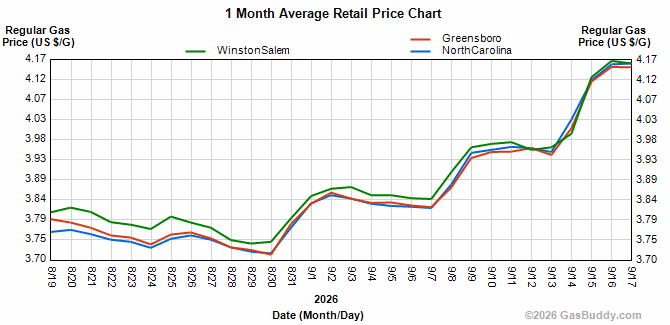
Nationally, the average price of regular gas hit $4.31 a gallon this week, according to AAA — up roughly 45% since the U.S.-Israel war with Iran began Feb. 28, and up further after a Sept. 11 drone strike forced Saudi Arabia to close its East-West pipeline, a critical alternate route around the blockaded Strait of Hormuz. Diesel hit a record $6.23 a gallon.
The national average for diesel reached $6.31, which is expected to drive up prices on consumer goods which rely on the fuel for transportation.
Featured Photo Credit
“United States Air Force Boeing VC-25B” by Liam Thompson is licensed under CC BY-SA 4.0. flickr.com/photos/204089279@N06/55533205116
###