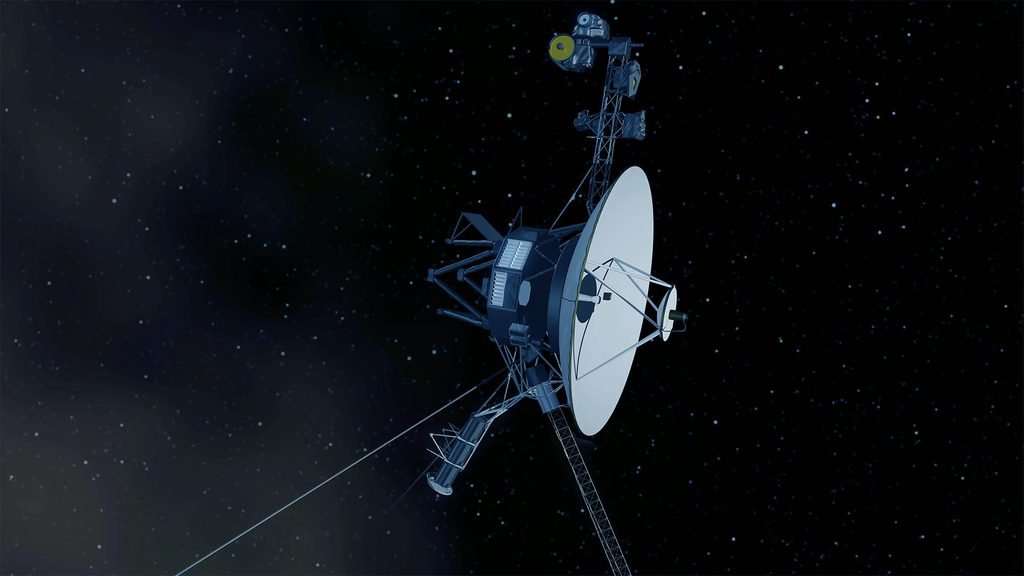
ASHEBORO N.C. (ACME NEWS) — Early Wednesday morning, NASA’s Voyager 1 spacecraft will reach a milestone never before reached as it becomes the first human-made object one light-day from Earth.
The spacecraft will cross the one-light-day mark at 5:16 a.m. EST Wednesday, Nov. 18, according to NASA. A light-day is just what it sounds like: the distance light travels in 24 hours. That works out to about 16.09 billion miles. By comparison, light takes only about 1.3 seconds to cover the 238,855 miles to the moon, about 8 minutes and 20 seconds to cover the 93 million miles from the sun to Earth, and roughly four hours and 10 minutes to cross the 2.8 billion miles to Neptune.
Launched Sept. 5, 1977, Voyager 1 was part of a mission designed around a rare alignment of Jupiter, Saturn, Uranus and Neptune that occurs about every 175 years and allows a four-planet tour with minimal fuel. Voyager 1 flew past Jupiter and Saturn, while its twin, Voyager 2, went on to visit all four planets.
Voyager 1 left the heliosphere — the bubble of space shaped by the sun’s influence — in 2012. It is now the most distant human-made object ever, traveling through interstellar space at roughly 38,000 mph.
At one light-day, even radio signals take more than a day to arrive, and the spacecraft’s reply takes another day to come back. NASA’s Jet Propulsion Laboratory says that makes even a simple command and confirmation take about 48 hours.
A look back
Voyager 1’s best-known photo was taken from far closer to home. On Feb. 14, 1990, from about 3.8 billion miles away, the spacecraft turned its camera back toward the inner solar system and captured Earth as a speck of light less than one pixel wide, caught in a scattered ray of sunlight.
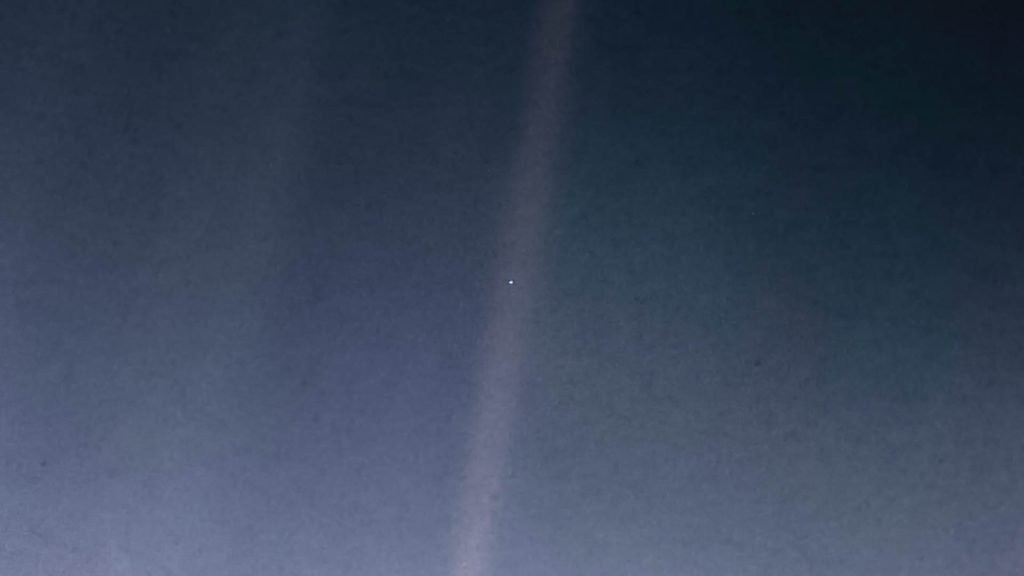
The image, known as the “Pale Blue Dot,” was part of a 60-frame “Family Portrait of the Solar System.” It was taken about 34 minutes before Voyager 1 shut off its cameras for good to save power. The nickname comes from a 1994 book by Carl Sagan, the Voyager imaging scientist who came up with the idea of pointing the cameras back at Earth.
At one light-day, Voyager 1 is now more than four times as far from Earth as it was when it took the picture. For the photo’s 30th anniversary in 2020, NASA released a reprocessed version created by JPL engineer Kevin M. Gill with input from two of the image’s original planners.
Take a look at the images Voyager 1 and Voyager 2 took during their flight through our solar system at: https://science.nasa.gov/mission/voyager/images-voyager-took/
Still talking after all these years
Voyager 1 is not exactly cruising. NASA’s Deep Space Network failed to pick up its signal Oct. 18 and 19. The signal returned Oct. 20. Engineers found that one set of thrusters had stopped working and that the spacecraft’s fault-protection system had switched to backup thrusters. NASA has not determined the cause.
Kareem Badaruddin, Voyager mission manager at JPL, said the team must “expect the unexpected” at this stage of the mission.
Power is the bigger long-term problem. The spacecraft runs on heat from decaying plutonium, and each Voyager loses about 4 watts of electrical power per year. Engineers shut down another instrument April 17 to stretch what is left, and only two science instruments are still operating. In early September, engineers swapped three devices for lower-power versions at once, a maneuver they have nicknamed the “Big Bang,” to avoid shutting down another instrument as early as summer 2027.
Voyager 2 actually launched 16 days before its twin, but Voyager 1 took a faster route and passed it Dec. 15, 1977. Voyager 2 is not expected to reach one light-day until November 2035.
Voyager 1 is headed toward AC +79 3888, also known as Gliese 445, an obscure star in the constellation Ursa Minor. It is expected to pass within about 1.7 light-years of it in 40,000 years. By NASA’s count, Wednesday’s milestone comes 49 years, two months and 11 days after launch.
###