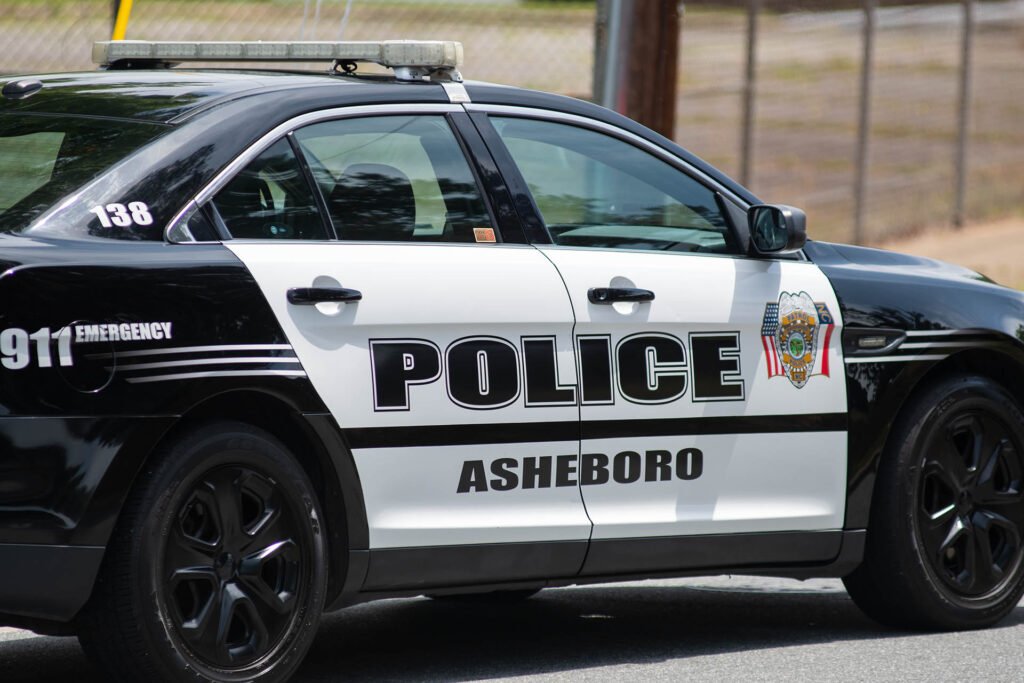
ASHEBORO NC (ACME NEWS) —It’s probably been a while since a sedan in your rearview mirror made you wonder if you were about to get pulled over. That’s because the vehicles once synonymous with police — the Charger, the Taurus, the Crown Vic — are disappearing from fleets, as manufacturers have shifted their product lines almost entirely to SUVs and pickup trucks.
“They’re pretty much all that is available in a police package,” explained Asheboro Assistant Chief of Police Jan Hanson. Both the Asheboro Police Department and the Randolph County Sheriff’s Office confirmed that sedans are simply no longer an option in most cases for departments looking to buy new patrol vehicles.
Starting in the late 2010s, automakers decided to shift focus away from sedans and toward more profitable SUVs and trucks.
Ford announced in its first-quarter 2018 earnings call that it would phase out the Focus, Fusion, Taurus, C-Max and Fiesta from its North American lineup, pointing to sliding sedan demand and thinner profit margins compared with trucks and SUVs. After the last Fusion came off the line in mid-2020, the Mustang has been the only sedan remaining in Ford’s North American product lineup.
Chevrolet built its last Malibu in late 2024, leaving the Corvette as the brand’s only remaining traditional car.
Stellantis — the company behind Chrysler, Dodge, Jeep and Ram in the U.S.— followed a similar path, ending production of the four-door Dodge Charger in December 2023. General Motors has held on longer through Cadillac’s luxury sedans, but its mass-market brands are effectively out of the sedan business as well.
That industry-wide retreat from sedans has reshaped police fleets across the country over the last few years. As the Crown Victoria and Taurus were phased out, the Ford Police Interceptor Utility — an SUV specially built for police work on the Explorer SUV platform — became the most common patrol vehicle in the country, with fleet managers pointing to standard all-wheel drive, more interior room for gear and pursuit capability as reasons for the switch.
Chevrolet’s police-package lineup followed the same trend, shifting to the Tahoe Police Pursuit Vehicle as the sedan-based Impala was phased out of municipal fleets nationwide.
Locally, that national shift shows up in what Asheboro police and Randolph County deputies are now driving.
APD’s fleet totals approximately 127 vehicles, a count that includes animal control, undercover and unmarked CID vehicles. Of those, 52 — about 41 percent — are SUVs or F-150s.
For APD, the shift to SUVs isn’t seen as a downside. “Most of our officers prefer the SUVs,” Asst. Chief Hanson said, even though she noted patrol cars aren’t strictly necessary within city limits. “There aren’t many places in the city that a patrol car can’t go,” she said, “so SUVs aren’t a necessity, but they’re pretty much all that is available in a police package.”
RCSO’s mix varies depending on how the fleet is measured. Across its entire fleet, the office estimated a roughly even split between sedans and trucks and SUVs. But within patrol specifically, the balance tips heavily toward non-sedan vehicles, at roughly 80 percent trucks and SUVs to 20 percent sedans.
In its approved 2025-26 capital outlay budget, the sheriff’s office earmarked $1.52 million for new vehicles — of the 32 planned purchases, exactly half (16) were trucks or SUVs, while the other half were listed only as “vehicle” or “pursuit vehicle,” with no type specified.
RCSO, which covers more rural and unpaved roadways than the city, said the change offers practical benefits. “SUVs and pickups tend to offer more room and are more practical for the Sheriff’s Office,” the office said, noting that only trucks and SUVs currently come in police-package trim. “Many parts of the county don’t offer paved roads like the city and often we are faced with uneven terrain and unpaved roads where the height offered by trucks and SUVs makes navigating the terrain much easier and safer.”
Sedans have long been favored in part for their lower center of gravity, which makes them less prone to rolling over and generally safer in a crash. Both agencies acknowledged that trade-off, but said the design of modern police-package SUVs and trucks addresses much of that risk.
RCSO explained that Police Pursuit Vehicle (PPV) and Special Service Vehicle (SSV) packages come with heavy-duty mechanical upgrades — pursuit-rated suspension, upgraded high-speed brakes, a high-output electrical system to run emergency equipment, and a stripped-down, durable utility interior built for the demands of law enforcement work. Those upgrades show up across the platforms both agencies use.
The Ford Police Interceptor Utility, built on the Explorer, typically ships with standard all-wheel drive and a pursuit-tuned suspension. Chevrolet’s equivalent, the Tahoe Police Pursuit Vehicle, is a larger, body-on-frame SUV favored by agencies that need more cargo room or towing capacity — and unlike the civilian Tahoe, it’s actually lowered slightly at the factory to improve high-speed stability. The Dodge Durango Pursuit split the difference, pairing a three-row interior with the option of a V-8 engine shared with Dodge’s sedan lineup.
“The advantage to trucks and SUVs is the clearance height, space and storage and hauling ability,” RCSO said. Chief Deputy Nunn told commissioners in 2025 that trucks and SUVs offer another advantage: they allow deputies to seize stolen property on site.
On the truck side, Ford’s F-150 Police Responder was the first pursuit-rated pickup to reach the market, aimed at agencies patrolling rural roads or unpaved terrain, and Chevrolet followed with a similarly rated Silverado. Both are built with the same reinforced suspension and braking upgrades as their SUV counterparts, with the added utility of a truck bed.
For now, both agencies say they’ll keep buying what the manufacturers are building — even if that means the classic police sedan is getting parked in past.
###