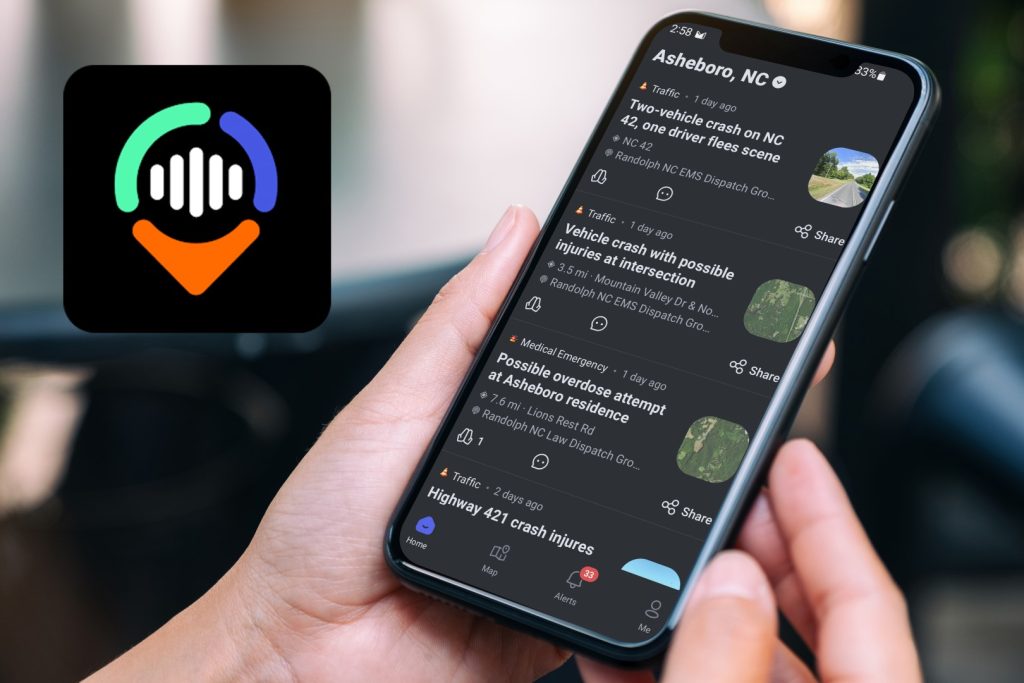
ASHEBORO, N.C. (ACME NEWS) — A popular AI-powered scanner app used to track local emergency incidents is drawing warnings from officials and first responders about its accuracy.
CrimeRadar: Dispatch Alerts, developed by Scoopz LLC, launched in May 2025 and has seen rapid growth — surpassing 1.2 million downloads on Android alone and ranking among the top free apps in the News & Magazines category on Google Play. The iOS version holds a 4.9-star rating on the Apple App Store. Both versions are currently free to download and use.
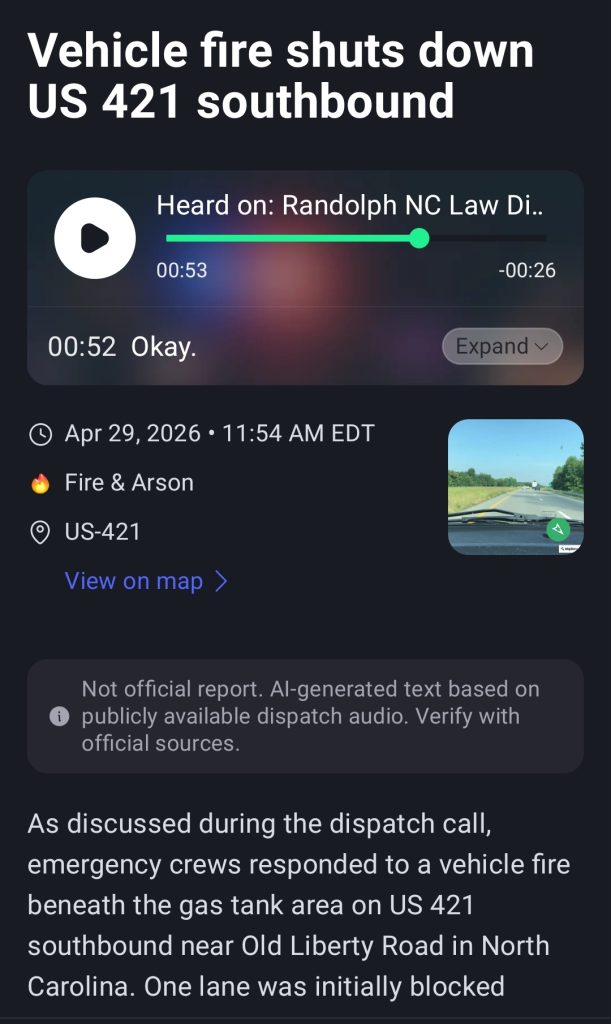
The app description says it monitors live first-responder radio and uses AI to summarize and map incidents in real time, alerting users about fires, accidents and police activity. Users can view details and listen to the original dispatch audio, though the app redacts some information — including exact street addresses and names — directly from the audio. Alerts are also delayed, posting anywhere from 5 to 30 minutes after the original transmission.
But that AI frequently has accuracy issues. Earlier this month, several residents submitted news tips to Acme News for a homicide reported by the app somewhere in the Archdale area. When reporters pulled up the dispatch audio inside the app, it referenced ‘signal 50,’ a radio code in Randolph County used to indicate that an incident is under control. The app had seemingly classified that code as a homicide.
Jared K. Byrd, interim chief of Randolph County Emergency Services, said the problem comes down to how much the app cannot hear. On a typical day, Randolph County 911 coordinates between 300 and 500 calls across more than 15 radio channels — along with in-vehicle software, mobile apps and telephone calls. An app that only listens to primary public safety radio channels is only getting part of the picture.
“Software that ‘listens’ only to the primary public safety radio channels to feed apps like Crime Radar are subject to miss out a lot of context, which can lead to errors or a misrepresentation of what actually occurred,” Byrd said.
That kind of misclassification also concerns Gary Jaggers, public information officer with the Liberty Fire Department.
“False information could spread and could cause panic in the community,” Jaggers said. “An example of that is we did a training at a church and we had people calling and thought the church was on fire.”
During a multi-agency training exercise at a local church, the department’s radio traffic was picked up by the app, which reported a working structure fire — prompting residents to call in with questions about a church fire that did not exist. The incident led Jaggers to issue a press release warning local residents about the concern over the accuracy of the app.
The department has since found a workaround. “We’ve done training exercises, announced at the beginning, and then about midway through, and we found that the app didn’t pick it up and it wasn’t published,” he said.
Despite the accuracy issues, Jaggers said he does not see the app as fundamentally different from technology that has been around for decades.
“We don’t look at it much differently than the police scanners that people have had for years. I guess this just opens it up for more people to have access to it.”
He said the Liberty Fire Department proactively posts information about training exercises, community events and larger incidents on social media, and will continue issuing press releases when something warrants wider public awareness.
“These things aren’t going to go away, and we do want to see that the public can stay informed,” Jaggers said.
Crime Radar’s own app store listing notes it “provides situational awareness based on public-safety dispatch audio” and is “not an official report or verified information” — a disclaimer that may be easy to miss.
Neither the Crime Radar team or its developer were immediately available for comment.
###