ASHEBORO N.C. (ACME NEWS) — Four rescued brown pelicans have been making themselves at home and wowing guests at the North Carolina Zoo since their arrival late last year.
The birds arrived at the zoo in September 2025, passing through a quarantine hold to screen for bird flu before an acclimation period eased them into life on public view. They took up residence in the Rocky Coast habitat — formerly occupied by Ronan the harbor seal and located near the porcupine exhibit — and have been on public view since mid-October 2025
“They’ve been delighting guests and staff alike ever since,” said Sara Pack, the zoo’s public information officer.
The pelicans’ path to Asheboro began at a wildlife rehabilitation facility in Florida, where all four were treated for serious wing injuries. Three of the birds required full wing amputations. The fourth avoided amputation, but a fused joint in her right wing prevents her from fully extending it.
Because brown pelicans rely on their wings to plunge-dive into water for fish, none of the four could survive independently in the wild. All four were deemed poor candidates for release and were in need of a permanent home.
“None of them could be candidates for release because if they can’t fly, they can’t hunt, they can’t escape predators; they’re vulnerable,” said Kirsten Perkins, a former Rocky Coast keeper who worked with the birds for seven months.
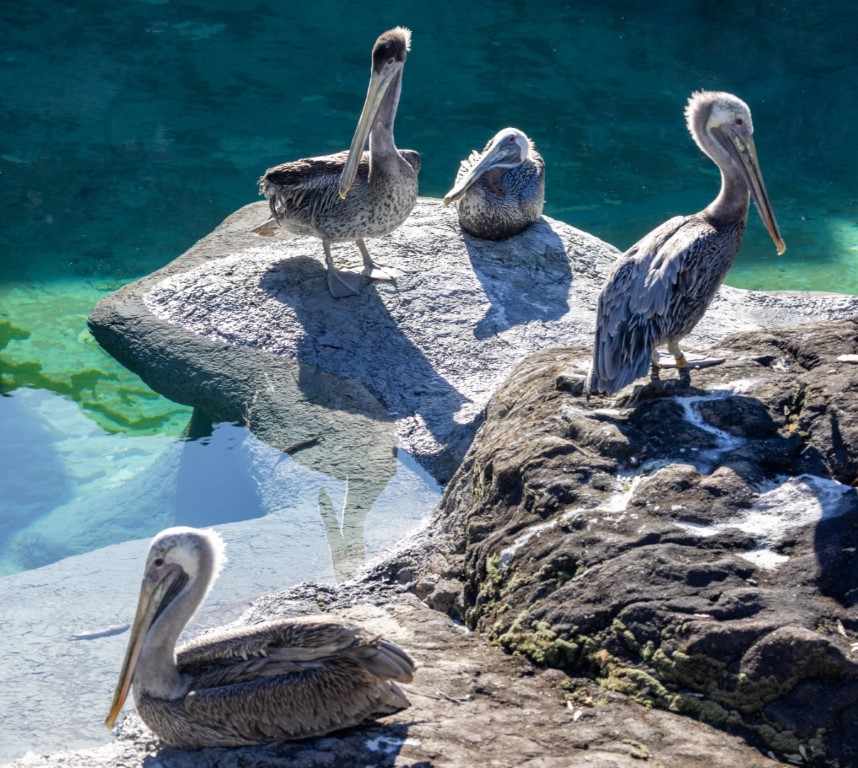
Those wing amputations are a common source of confusion for guests, said Kirsten Perkins, a former Rocky Coast keeper who worked with the birds for seven months. “That’s one of the most common questions we receive when people see us feeding or training the pelicans — ‘Why did you cut off its wing?'” she said. “We did not cut off its wing. It came to us that way.”
Perkins added that abandoned fishing line is a leading cause of wing injuries in wild pelicans, and she hopes visitors leave with a greater awareness of that danger.
Since their arrival keepers have focused on two goals: encouraging natural behaviors through environmental enrichment, and training the birds to accept food directly from staff. Most of their diet is now delivered through hands-on training sessions throughout the day.
Keepers have also noticed personalities that have emerged. Early on, one bold female led the way. Now, with brown pelican breeding season underway, a dominant male has stepped into the role of group leader, and the birds appear to be forming pair bonds.
“It’s been very interesting to see how their personalities have adapted — not just with the keepers, but amongst themselves and how that changes over time,” Perkins said.
Perkins, who recently moved from the Rocky Coast team to the zoo’s marketing
department, said the pelicans have developed a following among guests — in part because seeing them up close is a revelation for many visitors. “People are used to seeing them at a distance,” she said. “So seeing them so close up has been really exciting, because they’re like, ‘Wow, I didn’t realize these birds were so large.'”
Brown pelicans are among the larger shorebirds along the Atlantic coast. Despite their imposing size, they are surprisingly lightweight. Highly gregarious by nature, they live in flocks year-round — making the Rocky Coast habitat, where all four birds share the same space, a natural fit. North Carolina falls within their natural range, which stretches from Maryland south along the Gulf Coast and beyond.
Staff say the hope is that the pelicans — some of whom could live up to 30 years in captivity — will remain at the zoo for many years to come.
Visitors can see the pelicans at the Rocky Coast exhibit, located near the porcupine habitat in the zoo’s North America region.
###