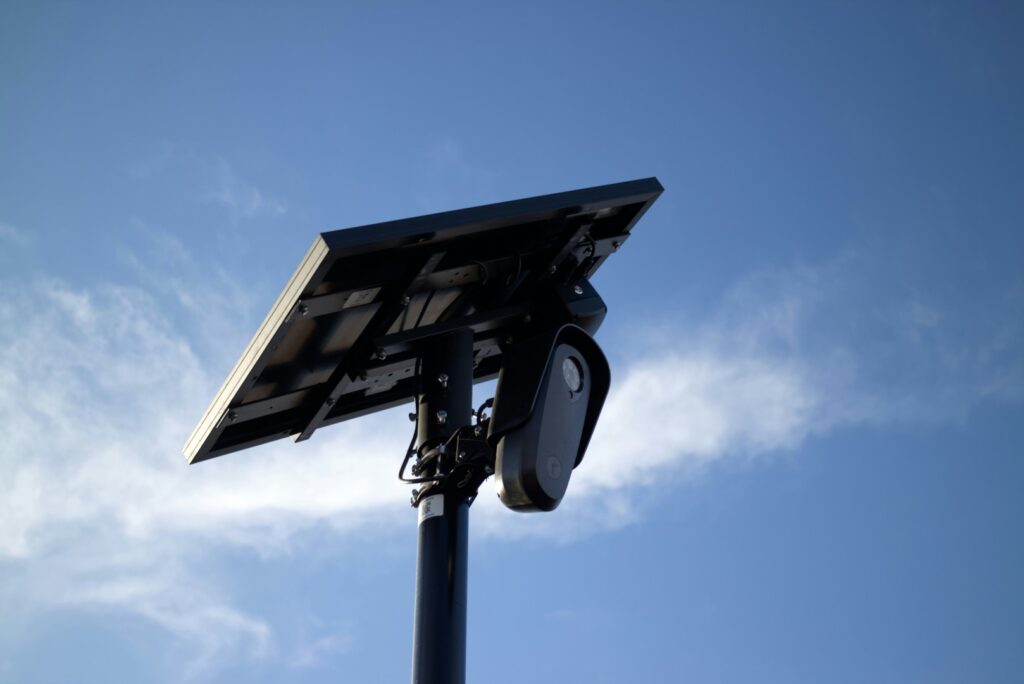
RALEIGH, N.C. (ACME NEWS) — The number of license plate cameras could be about to explode after state lawmakers used the budget to permanently extend a pilot program allowing police to place license plate readers on North Carolina’s state owned roads including interstates and highways.
Senate Bill 257, the $34.4 billion state budget signed into law July 7, 2026, creates a new, permanent law letting the State Bureau of Investigation (SBI) enter agreements with the N.C. Department of Transportation (NCDOT) to place license plate readers in the rights-of-way of state-owned and maintained roads, highways and interstates, including Interstates 40 and 85 and U.S. 64 and 29.
The SBI can enter into these agreements with NCDOT on its own or on behalf of local police departments and sheriff’s offices, giving those agencies a path to install cameras in those rights-of-way. Before the pilot program, agencies were limited to placing cameras on private property or local roads. The pilot gave them access to state rights-of-way for the first time, but that access was temporary, set to expire July 1, 2026. The new law makes it permanent, with no expiration date.
How the cameras work
Automatic license plate readers photograph every passing vehicle and use artificial intelligence to capture the plate number along with the vehicle’s make, model and color. The systems also log the date, time and location of each scan, and can note details like vehicle damage, decals and stickers.
As each vehicle is photographed, it’s checked against law enforcement “hotlists” — electronic lists of plates maintained by law enforcement that include stolen vehicles, stolen plates, vehicles used in felonies, wanted and missing persons including Amber and Silver Alerts, and protection orders. When a plate matches one on a hotlist, officers receive an alert.
But even when a passing vehicle isn’t a match, that data isn’t thrown out — it’s stored in a database that police can search later. Under N.C. state law, agencies can retain the data for up to 90 days unless the record is connected to an active criminal investigation, search warrant or ongoing case.
The pilot program
The SBI’s pilot program was authorized in 2023, but the first cameras weren’t installed until July 20, 2025. In its report to lawmakers earlier this year, the SBI said the program included 32 participating agencies: 12 police departments, 19 sheriffs’ offices and the North Carolina State Highway Patrol.
Those 32 agencies had requested to install 250 cameras, but as of March 15, 2026, only 17 agencies only had 140 cameras up and running so far. Another 75 camera locations were still working through NCDOT’s approval process or waiting on vendor installation.
To get a camera in the ground next to a state owned road, a participating agency first signs a memorandum of understanding (MOU) with the SBI, then works with its camera vendor to submit an “encroachment request” to NCDOT, which must approve the request before installation can proceed.
Some of the 140 installed cameras had been running for close to eight months; others had only been operating for a couple of months or weeks. Combined, they captured 152.7 million license plates between July 2025 and mid-March 2026. New Hanover County Sheriff’s Office alone accounted for more than 35 million of those plates from 19 cameras, the most of any participating agency. The Randolph County Sheriff’s Office, which installed four cameras under the program on March 2, 2026, recorded over 111,000 plates in its first 13 days of operation.
The SBI reported zero occasions during the pilot where captured data was retained beyond the state’s 90-day limit.
The SBI’s wish list
The SBI’s April report asked lawmakers for a two-year extension of the pilot, to July 1, 2028 — not the permanent status the budget ultimately gave it. The report also laid out two bigger plans for where the program could go next.
The first is a single, statewide database that would combine ALPR data from every vendor used by North Carolina law enforcement agencies — currently four, including Flock and ELSAG — into one system. Any “vetted” officer in the state could search it. The SBI, which already runs the state’s central criminal intelligence hub, said it was the natural agency to build and manage it. To do that, the SBI asked lawmakers for one new full-time position, an “ALPR Statewide Coordinator,” plus $225,000 a year to buy access to each vendor’s data.
The second plan is less defined. The SBI said it wants to help local agencies install more cameras along interstates and highways, with the eventual goal of covering “all entrances and exits to North Carolina.” The report doesn’t say how many cameras that would take or what it would cost — just that the SBI wants funding to offer grants for it.
Neither plan made it into this year’s budget. A full review of Senate Bill 257 found no funding for a statewide database, no new SBI position and no grant program for border-area cameras — only the provision making the SBI’s existing camera-placement authority permanent.
Asked in July about the status of both plans, SBI Public Information Director Chad Flowers declined to answer and referred Acme News back to the April report. “The SBI will be updating the legislature again each year with new data as required by law,” Flowers wrote.
Catching criminals vs. privacy concerns
In its report, the SBI highlighted several successful cases tied to ALPRs. Burlington Police Department reported 71 arrests or citations from May 2025 through mid-February 2026, along with 37 recovered stolen vehicles, six recovered stolen plates, four illegal handguns seized and 38 investigative leads generated.
Most of the other case examples in the report are anonymized, giving no indication of which agency was involved — including one in which investigators identified a suspect who had been repeatedly driving from western North Carolina to Atlanta to buy methamphetamine to sell back home; when they tried to stop his vehicle, he set it on fire and fled on foot before being arrested, and officers recovered 50 kilograms of methamphetamine and a handgun. Another anonymized case describes ALPRs helping locate a missing elderly woman with dementia whose car had broken down, leaving her stranded in freezing temperatures without food or water.
But success stories mask a broader concern: the system logs millions of drivers who are never suspected of a crime.
The Raleigh Police Department’s three cameras on state rights-of-way captured nearly 10.9 million license plates between July 2025 and January 2026. In that same period, the cameras generated 956 alerts to officers — 227 of them for stolen vehicles — according to the SBI’s report. That works out to an alert on roughly 1 in every 11,400 plates scanned, meaning well over 99.9% of drivers captured by Raleigh’s cameras were never flagged for anything at all.
“ALPRs are a vast, warrantless digital dragnet collecting data that can paint an intimate portrait of a driver’s life and even chill First Amendment protected activity,” said Electronic Frontier Foundation Privacy Litigation Director Adam Schwartz.
“Like most police technology, ALPRs are prone to ‘mission creep’: technology that was sold as a way to ‘catch killers’ can be used to target drivers who visit sensitive places such as health centers, immigration clinics, gun shops, union halls, protests or houses of worship,” Schwartz said.
The Institute for Justice, a nonprofit law firm, has documented at least 30 cases nationwide of police officers accused of using license plate readers to stalk romantic interests, most of them since 2024, highlighting how the systems can be abused by the officers who operate them.
“The fundamental problem with these systems is that they place private information about people’s movements over time in the hands of every officer,” said Michael Soyfer, an Institute for Justice attorney representing residents of San Jose and Norfolk in lawsuits challenging their cities’ ALPR surveillance networks. “Without the constitutional safeguard of a warrant requirement, that predictably allows officers to abuse their access to these systems for things like stalking romantic partners.”
Of the 32 agencies in the pilot program, only two—Asheville and Raleigh—included policies addressing misuse concerns. Asheville instructs officers to “attempt to avoid” surveilling attendees of political rallies, religious gatherings or protests. Raleigh prohibits surveillance “based solely on a protected class” such as race, sex or religion. The other 30 agencies have no such policies.
State law makes unauthorized use of ALPRs a Class 1 misdemeanor and requires participating agencies to adopt written policies. But the law provides no mechanism for enforcement, and individual agencies set their own standards with no state oversight of compliance.
Agencies also have little control over their data once it leaves local hands. The Randolph County Sheriff’s Office and Asheboro Police Department together operate approximately 15 ALPR cameras from ELSAG, the U.S. brand name of Italian defense and security contractor Leonardo. Each agency purchases, installs and maintains its own cameras; the state pilot program only lets participating agencies place cameras — in this case, four of the Sheriff’s Office cameras — on NCDOT rights-of-way rather than local roads or private property.
Asheboro Police Department data is uploaded to a server maintained by the Atlanta-Carolinas High Intensity Drug Trafficking Area, a federally funded network that includes more than 120 participating agencies across Georgia, North Carolina and South Carolina — among them the Randolph County Sheriff’s Office, which has access to query the network’s data, according to Asheboro police. It is not publicly known whether the Sheriff’s Office’s own camera data is likewise uploaded to the network.
“It’s bad enough that police agencies are conducting this warrantless mass surveillance, but they have even less control over the data when it’s shared with other agencies including federal agencies that may be pursuing political agendas with no regard for local and state laws,” said Schwartz.
###