Ongoing Coverage
This article is part of Acme News’ ongoing reporting on the Green Valley Farms rezoning request. Read our previous article: Randleman rezoning: landowner says no data center, company cites natural gas
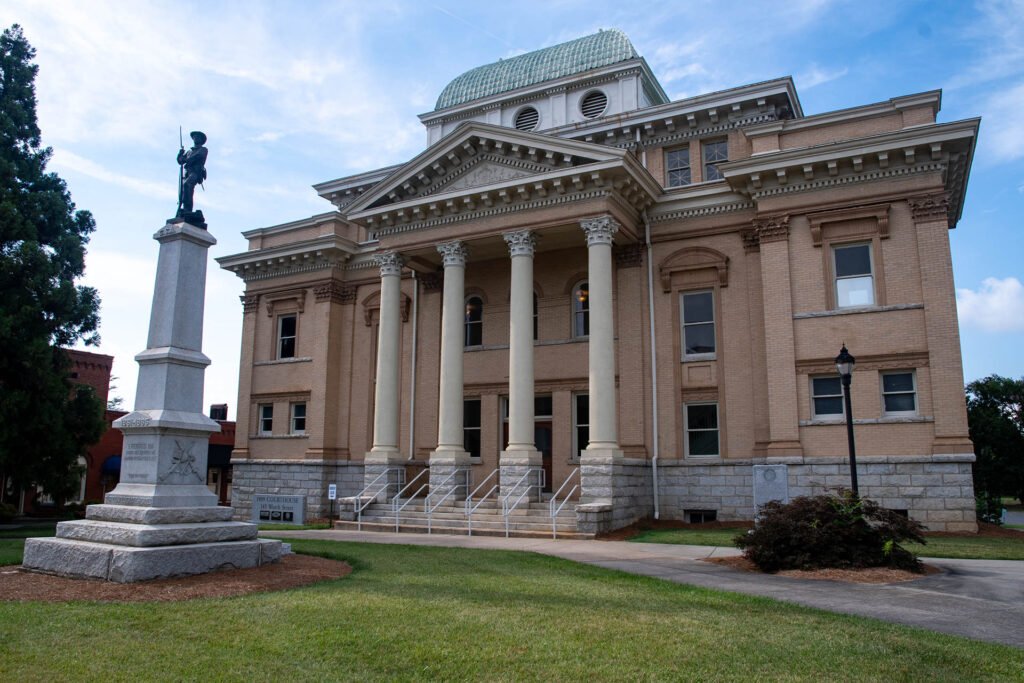
ASHEBORO N.C. (ACME NEWS)— The Randolph County Planning Board voted Tuesday night to deny a request to rezone 284.89 acres near Randleman to Heavy Industrial, with planning staff counted about 160 people standing in opposition.
The board voted unanimous by show of hands at the Randolph County Historic Courthouse. The motion to deny followed the recommendation of the county’s Technical Review Committee, which planning staff read into the record. The committee found the request did not meet the requirements of the county’s ordinance and Growth Management Plan. The motion also cited policies on industrial development, environmental protection and water-critical areas as reasons for the denial.
Board members said the applicant has 15 days to appeal. According to the county’s Citizen’s Guide to Land Development, the planning board’s decision on rezoning is final unless it is appealed to the Board of County Commissioners.
Rezoning application
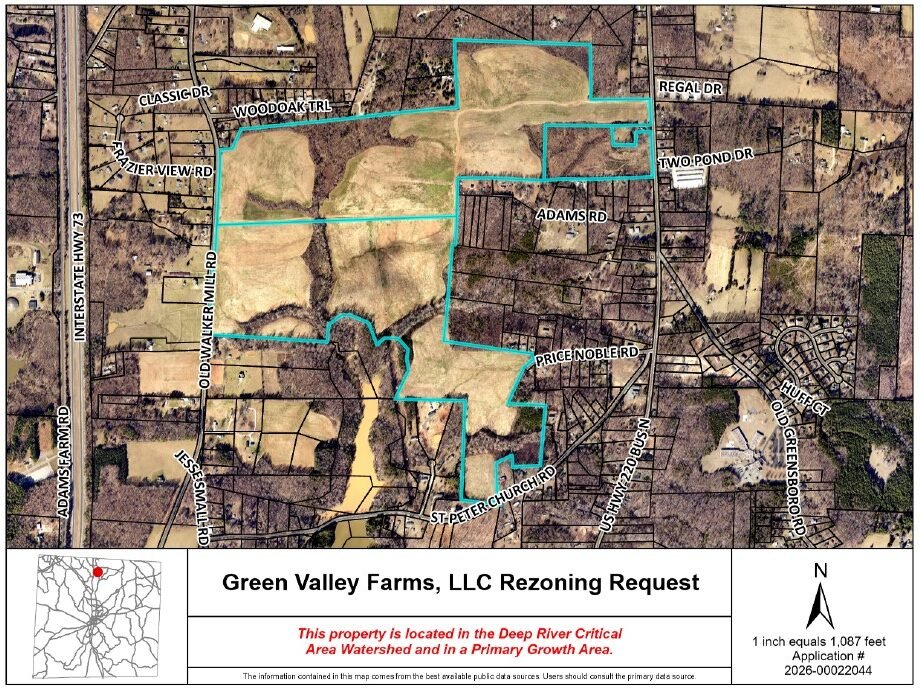
The decision stems from an Aug. 27 rezoning application submitted to the board by Green Valley Farms LLC, to rezone land near Old Walker Mill Road, St. Peters Church Road and U.S. 220 Business North from a mix of residential, agricultural and commercial zoning to Heavy Industrial. The application proposed no conditions and named no specific use, which means the board was asked to approve every use allowed under Heavy Industrial.
That list has 85 uses, county planning staff said in a call on Sept. 29, and a data center is not one of them. A data center would require a Heavy Industrial – Conditional District zoning, a separate zoning from Heavy Industrial.
Landowner Keith Hockett, reached by phone that day, told a reporter the project would be renewable energy. “It is not a data center, from what I have been told,” Hockett said.
In a later Oct. 1 call, Hockett said the buyer is Gateway City Energy, a Missouri company that spoke for the project at Tuesday’s hearing through Tom Muzzey, who is listed on the leadership page on the company’s website.
Muzzey was also listed as the contact person on the application. His name is what drew attention from members of a Facebook group opposed to data centers in the county, who connected the name to Gateway City Consulting, a Missouri firm whose website advertises services to data center developers.
Gateway City Energy provided answers to written questions on Oct. 1. The company confirmed that the Tom Muzzey listed on the application is the same Muzzey who is with Gateway City Consulting, and said it “work(s) as part of that firm.” It said its role in the land use process varies by industry and state.
Those answers also contained the first confirmed information about future plans with the company saying it hopes to generate power for economic development using natural gas.
The business model we hope to adapt is power generation that can be used for economic development. One of the biggest impediments to bringing tax growth and jobs into an area is lack of power. We plan to use natural gas to safely and efficiently generate power by working with the state’s DEQ for necessary permitting. We will then look to partner with an onsite customer that could include but not be limited to advanced or traditional manufacturers or smaller scale data processing. This will ensure that we are not increasing electricity prices or add additional stress to the grid. In turn we hope this generation will help decrease regional rates.
— Gateway City Energy
In another answer it said it wants to be transparent about any potential use “that would not exclude the potential for a smaller scale data center customer.”
Gateway declined to say whether it has a contract, option or other agreement on the three parcels, saying it did not want to comment on the owners’ nonpublic agreements. It said it has been communicating with the county “in good faith since at least early June” and was revising an application from June when the county adopted a new land use plan in August. It said it is working to adjust that application. County staff confirmed the Aug. 27 application is the only one on file for the property.
Hockett’s account does not match Gateway’s. In an Oct. 1 follow-up call, he said the application he and his brother signed did not mention a data center. “The zoning permit says it’s renewable energy,” he said. The county’s application lists no proposed use beyond a Heavy Industrial rezoning request.
Hockett described natural gas turbines fed by a gas line in front of the property but maintained his description. “It’s going to be renewable energy,” he said. (Natural gas is not a renewable energy source.) Told of Gateway’s language about a possible data center customer, he said, “We were totally against a data center,” and added, “If they have told me wrong, then it’s on them.”
Acme News asked Gateway City Energy via email on Oct. 1 if they could help explain the difference between its stated plans and what the landowner says he was told. The company had not responded as of publication.
Gateway executive outlines plans
Muzzey, who identified himself as a founder and partner in Gateway City Energy, told the board the company looks for sites suited to energy production. He said it has acquired rights to natural gas near the property and wants to produce electricity and put it on the grid. He said power generation is the first priority and that advanced manufacturing is its primary target.
Heavy industrial zoning would be “the first step.” Muzzey said the company doesn’t sign NDAs (non-disclosure agreements) with anyone, adding that the public would know what the company knows as the process moved forward. If people want the project, he said, the company would like to move forward; if not, “it probably doesn’t work.”
Gateway said they had been “in conversations with Duke” about an interconnection, according to Muzzey, who said that the company can’t “just make a bunch of power and force them to take it.” “We’re working through that conversation,” he said. In an earlier call, Hockett said Duke had already signed off on a connection if the project is permitted. Duke Energy said through a spokesperson it could not locate any project or connection, later adding that sometimes they won’t “know about various projects until they get to a later stage.”
Muzzey did not mention a data center in his remarks to the board. Asked about water and sewer, he said the site has access to both.
Water authority: site ‘not appropriate’
Greg Fleury, executive director of the Piedmont Triad Regional Water Authority, told the board the opposite on utilities: no public water or sewer is currently available at the site, and regional wastewater capacity is limited. He said the authority’s long-term plan for the area did not consider industrial use.
Fleury said the authority’s position is that the site “is not appropriate for Heavy Industrial use, no matter what the application would be.” He said the land drains directly to Randleman Lake, making stormwater controls hard to implement, and that a power generation facility would add risks including thermal discharge, chemical spills and cooling tower blowdown. He said the authority bought land on the south side of the property about 18 months ago because of pollution and buffer concerns.
Residents and a competing bidder
Every other speaker who addressed the board opposed the request. Neighbors raised concerns about the Deep River critical watershed, well water, noise, lighting, traffic and Level Cross Elementary School, which speakers said is less than half a mile away.
Joshua Yates, who lives across Old Walker Mill Road from the property, read policies from the Growth Management Plan that call for discouraging industrial development in water-critical areas. Frances Atkins, who lives in the adjoining Cedar Run community, said she and her neighbors had trouble finding the rezoning sign in tall grass and that several homes in the area have had well problems. A board member later said staff can’t place signs in the road right-of-way because the state Department of Transportation removes them.
Jonathan Moody —a nearby resident— whose organization bid on the property at a July 2025 auction and later passed on an offer to buy it, said the land is under contract to a new buyer. Gateway has declined to comment on any agreement with the owners. Moody said Hockett’s statement that it was not a data center and Gateway’s statement that it would not rule one out show “how little the public knows about the purchaser and its plans.”
Moody also said natural gas turbine generation is not named among the heavy industrial uses. The list of 85 uses allowed in Heavy Industrial in the board’s agenda packet does not include electric power generation or natural gas turbines. Section 619 of the county’s Unified Development Ordinance requires the planning director to classify an unlisted use in writing, and Moody said he had seen no such determination. Planning staff said Section 619 applies when the county receives a request for an unlisted use, but did not provide further details.
Board: ‘vague for us, too’
Board members said the type of request left them without tools. “It’s vague for us, too,” one member said, noting that every use allowed in Heavy Industrial would be permitted if the rezoning passed. The member said an outright rezoning means the board cannot require buffers or other mitigation, and that the Growth Management Plan calls for discouraging industrial development in water-critical areas.
Another member told the crowd that having 160 people in the room opposing the rezoning didn’t make them right or wrong, only “well organized,” and said the board weighs the evidence without preconceptions. A third said the project was “not consistent, reasonable, and in the public interest.”
What a data center would require
Recent changes to the county’s Unified Development Ordinance (UDO) added several requirements before a data center could be built, even if the rezoning had passed. The county’s UDO lists data processing facilities only in the Heavy Industrial – Conditional District, which limits a property to one use with conditions. The ordinance also requires outdoor equipment to sit at least 1,000 feet from homes, schools, churches and parks, a preconstruction noise study, a cooling system certified by an engineer, and a decommissioning plan backed by financial assurance. It allows on-site generators only for emergency power and limited testing, and requires a grid connection before final occupancy.
Closing remarks
In closing remarks, Muzzey said permitting setbacks and air and water quality rules would limit what could be built, and that only about 220 of the 284 acres were likely usable. He said that he did not want to be the one to contaminate the watershed and that “if there’s not the appropriate use for this, then that’s okay.”
Acme News asked Gateway City Energy about its future plans, including whether it will appeal. The company had not responded as of publication.
###