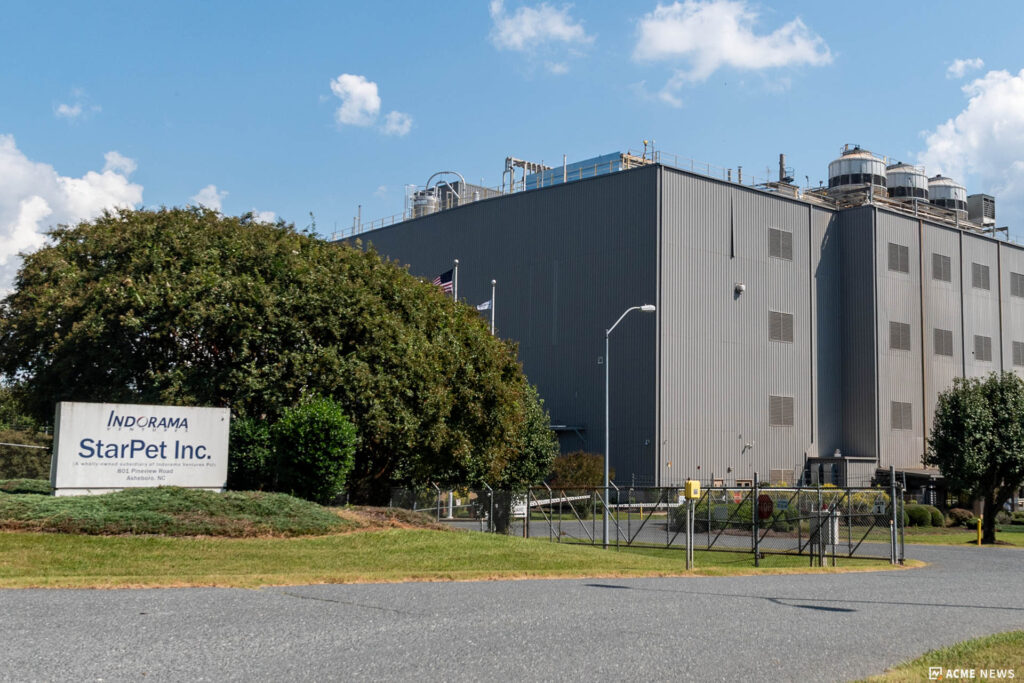
ASHEBORO, N.C. (ACME NEWS) — A spike in 1,4-dioxane levels recorded by state regulators this month has been linked to maintenance on a pretreatment system at StarPet, according to city officials.
Testing on July 10 detected 1,4-dioxane at 2,010 parts per billion (ppb) in discharge from the Asheboro Wastewater Treatment Plant, according to the North Carolina Department of Environmental Quality’s Division of Water Resources. The EPA classifies 1,4-dioxane as likely to cause cancer. State regulators set the safe level for downstream water supplies at 22 ppb or less, making the recent discharge more than 90 times the limit.
According to NCDEQ, the elevated levels triggered notifications to be sent to several downstream drinking water utilities, including Bladen Bluffs Water System, Brunswick County, Cape Fear Public Utility Authority, the City of Dunn, the Fayetteville Public Works Commission, Harnett Regional Water, and the City of Sanford.
All told, roughly one million residents depend on drinking water supplied by these systems. Federal health officials warn that long-term exposure to even trace amounts of 1,4-dioxane can increase cancer risks.
What Happened?
The spike traces to StarPet, a plastics manufacturer in Asheboro owned by Thailand-based Indorama Ventures. The company discharges into the city’s wastewater system with its discharge permit allowing as much as 70,000 gallons daily to be sent to the treatment plant.
To reduce 1,4-dioxane levels before wastewater reaches the city’s treatment plant, StarPet installed a pretreatment system in November 2020. However, a lawsuit filed by the Southern Environmental Law Center alleges the system went offline six times between 2021 and 2025, causing 1,4-dioxane levels to spike downstream each time. According to municipal data cited in court filings, concentrations from StarPet reached up to 375,000 ppb during these outages. Although diluted by other wastewater at the city’s facility, discharges into Hasketts Creek still peaked at 3,520 ppb—163 times the permitted limit. The recent spike followed this same trend.
Asheboro Wastewater Treatment Plant — 1,4-Dioxane Levels
Grab samples, January 2024 through July 2026 (μg/L)
“StarPet was doing maintenance on their treatment column, and they took it down, but this time they actually brought in holding tanks to store their wastewater while the maintenance was being done,” said Michael Rhoney, Water Resources Director for the City of Asheboro.
Rhoney said StarPet attempted to treat the stored water before discharging, but something just didn’t work correctly.
“We did everything right, but the only thing we figured is in the startup it just took a while for it to get to the proper operating conditions. So it was definitely just a freak thing that happened, but we’re dialing in on how to get it figured out,” said Rhoney in a phone call Thursday afternoon.
Ongoing Legal Battle
Discharges of 1,4-dioxane are at the heart of a federal lawsuit filled in June 2025 by the Southern Environmental Law Center (SELC) against the City of Asheboro and StarPet Inc, on behalf of Cape Fear River Watch and Haw River Assembly.
The lawsuit points to more than a decade of discharges from StarPet, a plastics manufacturer sending water contaminated with high levels of 1,4-dioxane—a byproduct of the plastics manufacturing process— into the city’s wastewater system, where it passes through Asheboro’s treatment plant unchanged and flows downstream.
Asheboro has sought to dismiss or delay the case, arguing that similar issues are already being fought in state court. The city invokes a “permit shield” defense, claiming its 2012 wastewater permit — reinstated in 2024 — did not include 1,4-dioxane limits when issued, and therefore the city cannot be sued for discharging it.
The permit challenges and the legal battle have not been cheap for Asheboro’s water and sewer customers. Between early 2024 and early 2026 alone, the city paid the Raleigh law firm Cranfill Sumner LLP $695,469 across 37 invoices to fight the state and federal regulators. When combined with payments to two other law firms, the total legal bill tracked by city records since May 2020 reaches $734,535.
All of those payments were drawn from the city’s Water Resources fund — the account that finances utility operations — meaning water and sewer ratepayers are footing the bill for the legal defense, not the city’s general fund.
DEQ says they are continuing to monitor the levels of 1,4-dioxane discharged by wastewater treatment plants in the Cape Fear River Basin. “Significant reductions have occurred at some wastewater treatment plants through a collaborative effort with the Environmental Management Commission (EMC), DEQ and municipal operators. DEQ continues to work with the remaining municipal operators.” Asheboro remains one of those operators.
###