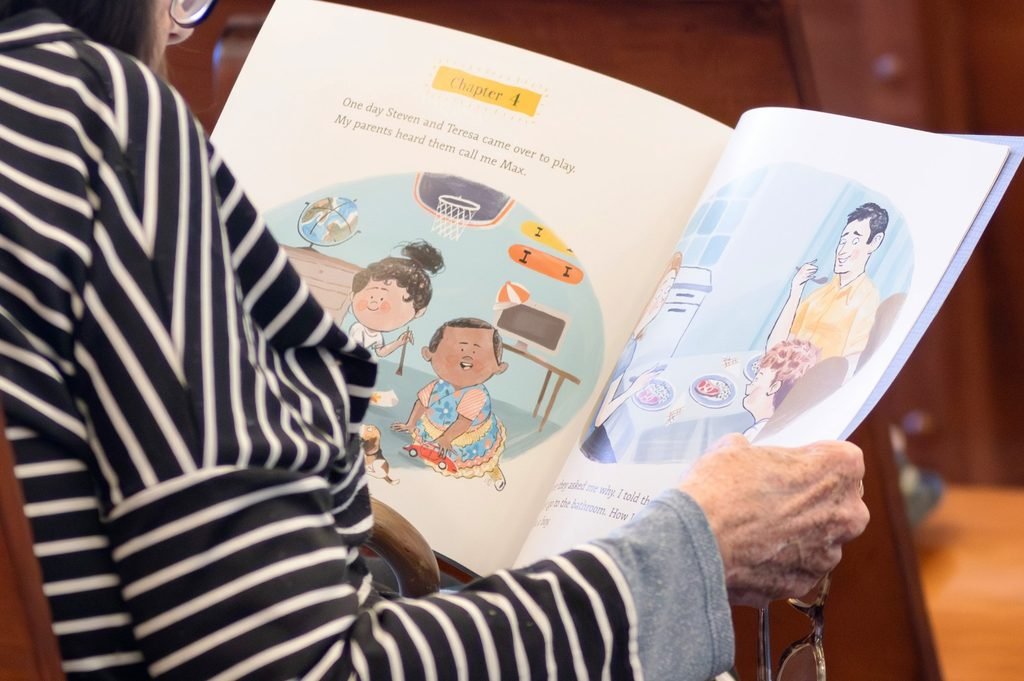
ASHEBORO N.C. (ACME NEWS) — One year after the library board voted to keep “Call Me Max,” a decision that led to the board’s wholesale replacement, local advocates haven’t stepped back, turning a single moment of protest into a movement of monthly read-ins, comments and petitions.
Started with a book challenge
On Sept. 9, 2025, county resident Doris Welborn asked the Randolph County Public Library to remove the children’s picture book “Call Me Max” from library shelves because of its transgender protagonist. Welborn wrote that she had checked out the book for her grandson without knowing its topic and in her request said that, as a taxpayer, spending money “to put this left ideology in minds of young children who are innocent is beyond comprehension.”
Library Director Ross Holt rejected her request Sept. 23, writing that the book was appropriately selected and was added to the Children’s Room in 2021 after parents asked for a book to help children understand transgender issues. Welborn appealed, and on Oct. 9, 2025, the Library Board of Trustees voted 5-2 to keep the book in the children’s collection. More than 100 people packed the meeting at the Historic Courthouse, and nearly 30 spoke during public comment.
Two months later, on Dec. 8, the Randolph County Board of Commissioners voted 3-2 to dismiss the entire board and dissolve its bylaws. Commissioners Darrell Frye, Kenny Kidd and Lester Rivenbark voted for the resolution. Commissioners David Allen and Hope Haywood voted against it.
According to the meeting minutes, Rivenbark said the trustees followed policy but do not represent what “Randolph County citizens believe.” Kidd said they do not represent the community’s values and that “saving the souls of children is important,” a thought he said did not enter the trustees’ minds.
Getting Organized
Many of the residents who spoke for keeping “Call Me Max” in October were also at the Historic Courthouse on Dec. 8 to object to removing the board itself. Forty speakers were chosen for public comment that night.
The effort began with little notice. Susie Scott, one of the organizers, said residents learned of the book challenge only about three days before the October hearing. She said they spread the word through friends, churches, the NAACP and other community groups.
“Most of us didn’t know each other at the time,” Asheboro resident Todd Dulaney said.
Dulaney, who frequents municipal meetings, said he had never attended a library board meeting before the challenge. He began attending and posting about what he saw on Facebook. After the dismissal of the library board, the loose network of residents grew.
Jennifer Eagle, who had commented at both meetings and holds a library degree, started a private Facebook group for people who had commented on Dulaney’s posts. She said she wanted a way to keep everyone in touch and decide what to do next. Dulaney had already started two petitions, one on Change.org and one through Fight for the First. Asheboro resident Gin Wall said members began meeting weekly on Zoom shortly after the board was dissolved.
The first read-in was held on Jan. 3 at the Asheboro Public Library. More than 100 people read silently for two hours, and Scott said the parking lot filled. She said the group borrowed the idea for a read-in from the national group Red Wine & Blue. The read-ins then moved from the library to the meeting room at the Historic Courthouse just before commissioners meetings.
“We wanted them to see the amount of support we had,” Scott said.
From February through July, the group held a read-in before every commissioners meeting. The tenth read-in was Oct. 5, held during Banned Books Week. Participants were encouraged to bring a banned or challenged book. Turnout is typically 20 to 30 people, Scott said, and members speak during public comment each month.
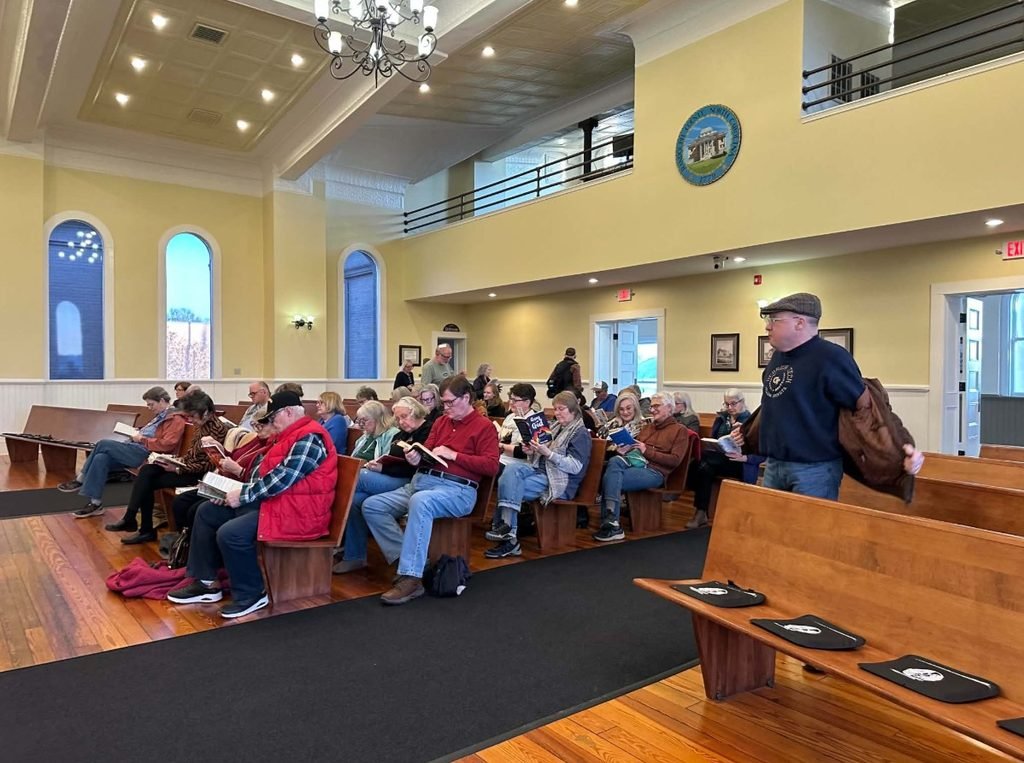
Being seen is the point, she said. “When we see the county commissioners come in and we see them sigh, they look around inside because what do you do to fight back against people quietly reading in their seats to support your library?”
Prominent North Carolina writers have joined in. Former N.C. Poet Laureate Joseph Bathanti spoke at the April 6 meeting. Novelist Jill McCorkle and current Poet Laureate Jaki Shelton Green took part in the May 4 read-in.
Wall said showing up at the meetings has been an education. “If you start attending, it’s amazing what you can learn that goes on in your community and at those meetings,” she said.
The group kept pressing as the county rebuilt the board. On Dec. 11, Commission Chairman Frye said commissioners intended to appoint a new board and rewrite the bylaws, including terms and representation.
On March 2, commissioners approved the new bylaws, which replaced 2018 revisions to the original 1993 version. County Attorney Ben Morgan described the changes as a modernization effort rather than a radical shift, aimed at bringing the library board in line with the procedures of other county boards, such as the Board of Health.
“We’ve simply tried to clarify some of the vagueness within the document itself,” Morgan told commissioners. “There aren’t a lot of other significant changes.”
The changes that were made mostly involved the board’s makeup. Trustee terms were cut from six years to three, with a cap of three consecutive terms. The board grew to nine members, with a seat for each of the system’s seven library branches and two each for Asheboro and Archdale. Under the old bylaws, no more than two trustees could come from the same census township. A county commissioner now fills one of the board’s non-voting seats, replacing a liaison previously appointed by the Asheboro City Council.
The process for challenging library materials stayed largely the same. Complaints now go first to a three-person staff panel made up of the library director, assistant director and the relevant department head. Patrons who are unsatisfied can appeal to the trustees, who retain final authority. Under a separate 2023 policy, a book that survives a challenge cannot be challenged again for five years.
Eagle said the process did little to change her view of why the old board was removed. Commissioners first said the trustees followed policy, she said, then rewrote the rules and replaced the board.
“It wasn’t actually about the rules,” she said. “It was just about who the trustees were.”
Charlie White, who also spoke at the webinar, argued the stakes reach beyond one board. He said state law allows trustees to be removed only for specific causes, such as incapacity or misconduct, and that the commissioners’ resolution made no such findings. The minutes show the commissioners acted under N.C. General Statute 153A-77(a), assuming direct control of the board.
“You protect the principle when the stakes seem small so that it’s still there when the stakes aren’t,” White said.
In July, the group adopted the name the “Library Liberation League,” and began discussing plans to expand.
National partners
PEN America —a non-profit whose stated goals are to to raise awareness for the protection of free expression through the advancement of literature and human rights— contacted the group in early Dec the day after the dismissal of the library board. Scott said the group decided to take the read-ins to commissioners meetings as PEN America began helping.
The Fight for the First petition began gaining steam in mid-January and topped 800 signatures. Scott said the platform also supplied resources and a way to email supporters. An EveryLibrary email campaign sent more than 100 messages to commissioners.
On April 13, Read Free NC published an essay documenting the grassroots response. It described a simple blueprint: show up, stay informed, talk with neighbors and keep going.
“The Library Liberation League has created a model that other communities facing challenges to the freedom to read can learn from,” Tasslyn Magnusson, senior advisor to PEN America’s Freedom to Read team, said in comments provided by Dulaney. “PEN America’s role is to help grassroots groups like this connect to resources, expertise, and one another — but the real power comes from the people on the ground who know their community and are willing to stand up for it.”
On Sept. 28, PEN America hosted an online discussion, “Open Shelves: Randolph Voices for the Freedom to Read.” Bathanti and McCorkle interviewed five local residents about the past year. The recording was later posted online. McCorkle told the group, “I feel you all are supplying the blueprint for what other communities can do.”
The local fight comes as book removals continue nationally. A PEN America report released this month counted 11,982 school book bans affecting 7,370 individual works. Many were in Florida and Texas, according to The Associated Press. The report covers school libraries, while Randolph County’s dispute involved its public library.
What’s next
The league is now looking beyond the county line. Members have talked with advocates in Alamance County. They are reaching out to similar groups across North Carolina about a statewide network, including a digital hub, in which local groups would share information and strategies while keeping their own identities.
At the webinar, a Durham County resident asked what people in other counties could do. “I think there’s a lot of work to be done in North Carolina,” Magnusson said. Bathanti told participants the problem is not unique to Randolph County.
“It’s going to keep happening. It’s not going to go away,” he said.
Closer to home, the group is watching the new board. The reconstituted Library Board held an orientation on Aug. 24 and is scheduled to hold its first regular meeting at 6 p.m. Oct. 13 at the Randolph County Agricultural Center. It is expected to elect a chair and other officers. Scott said league members plan to attend those meetings in addition to the commissioners’ meetings.
Scott’s advice to other communities was short. “You can affect change in your community, especially at the local level,” she said.
###