Update – Oct. 1
Gateway City Energy responded to Acme News’ questions after this article was published. In its written response, the company said it plans to use natural gas to generate power and that it wants to be “transparent about any potential use that would not exclude the potential for a smaller scale data center customer.” The company’s statement on its plans reads in full:
“The business model we hope to adapt is power generation that can be used for economic development. One of the biggest impediments to bringing tax growth and jobs into an area is lack of power. We plan to use natural gas to safely and efficiently generate power by working with the state’s DEQ for necessary permitting. We will then look to partner with an onsite customer that could include but not be limited to advanced or traditional manufacturers or smaller scale data processing. This will ensure that we are not increasing electricity prices or add additional stress to the grid. In turn we hope this generation will help decrease regional rates.”
— Gateway City Energy
Read the company’s full response (PDF)
In a follow-up call, landowner Keith Hockett said that, from what he has been told, the project is not a data center, and that he and his brother were against one. He said the project would use a natural gas line that runs along the property to feed gas turbines that put power back on the grid. He remained certain the application he signed was for renewable energy. The county’s application lists no proposed use and no conditions.
This is a developing story. Acme News is seeking more information and will provide a full update. Anyone with information is encouraged to contact the news desk at newsdesk@acmenews.net, or submit a news tip.
RANDLEMAN N.C. (ACME NEWS) — A Randolph County landowner says a rezoning request fueling data center rumors online is actually for a renewable energy project, and county officials confirm the application couldn’t authorize a data center anyway.
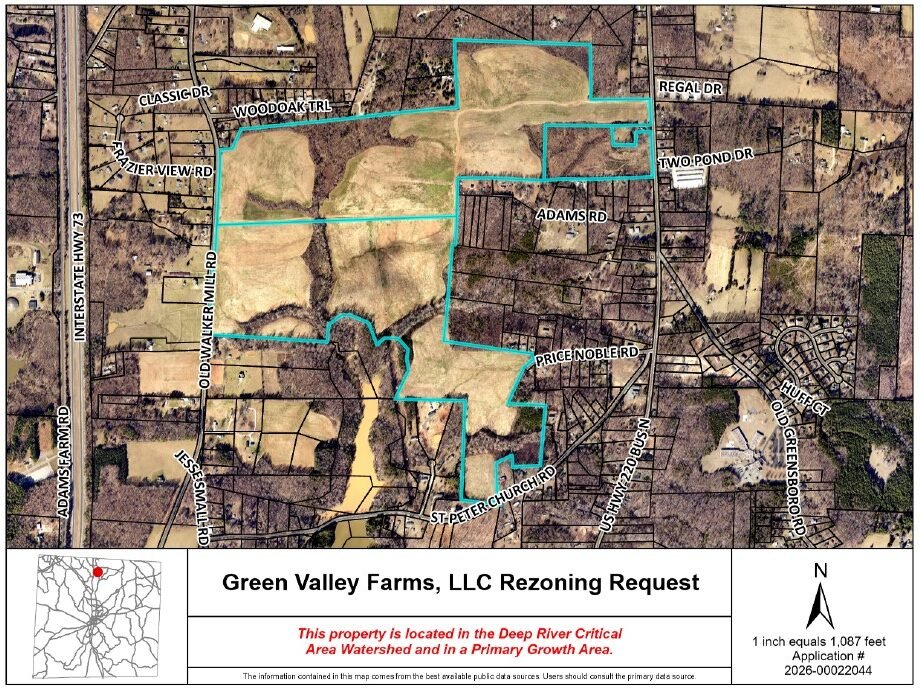
Green Valley Farms LLC, a family-owned farm business, submitted a rezoning application to the Randolph County Zoning and Planning Board on Aug. 27, asking the county to rezone 284.89 acres near Old Walker Mill Road, St. Peters Church Road and U.S. 220 Business North from a mix of residential, agricultural and commercial zoning to Heavy Industrial (HI).
Under Randolph County’s zoning rules, Heavy Industrial (HI) is reserved for “industries whose normal operations include dust, noise, odor, or other emissions that may be objectionable,” according to the county’s Unified Development Ordinance — a category that covers everything from foundries and asphalt plants to warehousing and energy storage facilities.
The rezoning application itself doesn’t specify what the property would be used for. County records list only “HI REZONING REQUEST” as the proposed use, with no conditions attached. Unlike a conditional rezoning —which locks a property to one specific use— a standard Heavy Industrial rezoning carries no restrictions, meaning the Planning Board is being asked to approve the full range of allowed uses, not a single project.
Keith Hockett, who co-owns the property with his brother, said in a phone call that online speculation linking the rezoning to a data center is false. “It is not a data center, from what I have been told,” Hockett said. “I signed the application to have it rezoned, and it’s renewable energy.”
“They’re actually going to build their own transformer station down here,” Hockett said. “There’s a power line that runs right across there, and Duke Power has already signed off on it for them to go ahead, if they get permitted for it, to go ahead and hook onto it and put power back on the grid. So it’s actually going to help this community tremendously.”
Hockett said he was told the project aims to address growing demand in southern Guilford County and northern Randolph County.
Duke Energy, contacted late Tuesday, said it was unable to confirm the project or provide specific details by Wednesday. “Sometimes we don’t know about various projects until they get to a later stage,” a company spokesperson said.
Hockett said he and his brother reviewed the application closely before signing it. “If it is a data center, it was not on the application,” he said. “We looked it over really, really well before we ever signed it.”
County officials said the application alone could not authorize a data center. Data processing centers require Heavy Industrial – Conditional District (HI-CD) zoning, meaning even if the Heavy Industrial rezoning is granted, the landowners would have to request another rezoning to HI-CD and meet the requirements in the recently updated UDO before any plans for a data center could move forward. Those recent changes to the UDO would require an impact study, a preconstruction sound study, a decommissioning plan and more.
The rezoning application lists Tom Muzzey as the contact person. It was Muzzey’s connection to Gateway City Consulting — a Missouri-based firm whose website advertises land acquisition and zoning and permitting services for data center developers — that first raised suspicion among nearby residents. After seeing the county’s rezoning notice signs posted on the property, some residents looked up the application, found Muzzey’s name and traced his ties to Gateway City Consulting and its data center work, fueling rumors on Facebook that the land may be a future location for a data center.
Muzzey also appears on the leadership page of Gateway City Energy, a related company that describes itself as providing “behind-the-meter energy solutions for data centers & industrial customers.” Gateway City Energy’s website lists services including battery energy storage systems, substations and ring-bus infrastructure, and grid interconnection.
Gateway City Energy and Gateway City Consulting share leadership: both list Doug Mitchell as founder and CEO, and both list Muzzey among their leadership team members. Muzzey’s bio on the Gateway City Energy site describes him as “an executive operator and business owner specializing in capital-intensive industries,” with a background in concrete and construction and more than $200 million in financing arranged through bond issuance and public-private partnerships.
Neither Gateway City Energy, Gateway City Consulting nor Muzzey had responded to multiple calls and messages with questions about the project or any agreement with the landowners.
Randolph County planning staff have recommended the Planning Board deny the rezoning request, citing conflicts with the county’s Growth Management Plan. The property sits within the Deep River (Randleman Lake) watershed critical area, a state-protected zone with additional development restrictions.
Joshua Yates, a nearby resident expressed concerns about the project. “Heavy industrial zoning is listed as causing significant noise, pollution, etc that could be deemed undesirable to residents,” said Yates. “Regardless of the proposed use of the property heavy industry does not belong on a critical watershed and could have catastrophic consequences to our community and water supply.”
Hockett said financial pressure led him to sell the land. “That’s the only reason I’m selling it,” he said, adding that the family plans to keep its original homestead on Hockett Dairy Road, which he said has been in the family since 1812.
The Planning Board’s public hearing is scheduled for 6 p.m. Oct. 6 at the Randolph County Historic Courthouse, 145-C Worth Street, in Asheboro.
⚠️ DEVELOPING STORY
This is a developing story. If we receive updates, we will provide them as they are made available. Anyone with information or updates is encouraged to contact the news desk at newsdesk@acmenews.net, or submit a news tip.
###