ASHEBORO, N.C. (ACME NEWS) — Duke Energy Carolinas keeps about 21 cents of every dollar its customers pay as profit — already one of the highest margins of any electric utility in the country. Now it’s asking regulators for more.
Customers across the state began receiving notices in recent months about a proposed rate hike after Duke Energy — the state’s regulated electric monopoly — filed an application with the North Carolina Utilities Commission in November requesting to raise rates by approximately 15% over the next two years.
If Duke’s proposal is approved as filed, the average residential customer’s monthly bill would rise from $144.98 to $162.20 in 2027 and $168.54 by 2028, according to figures in those notices.
North Carolina Attorney General Jeff Jackson says Duke’s numbers don’t add up. Expert testimony filed by his office May 29 with the Utilities Commission argues the real increase is far larger than Duke has advertised and that the company’s requested profit margin is too high.
“This proposed increase is too high for families, and it’s more than Duke needs to meet our growing demand for energy,” Jackson said. “We can bring that number way down, save families money, and still build everything we need to keep up with growth.”
The Public Staff at the Utilities Commission — a separate state agency that reviews utility rate requests on behalf of consumers — agreed, filing its own analysis the same day recommending a dramatically smaller increase.
Questioning the math
Duke has described its application as an “approximately 15%” rate increase — language the company used in notices mailed directly to customers. Analysts for the attorney general say that number is misleading.
Duke has described its application as an “approximately 15%” rate increase — language the company used in notices mailed directly to customers. Analysts for the attorney general say that number is misleading.
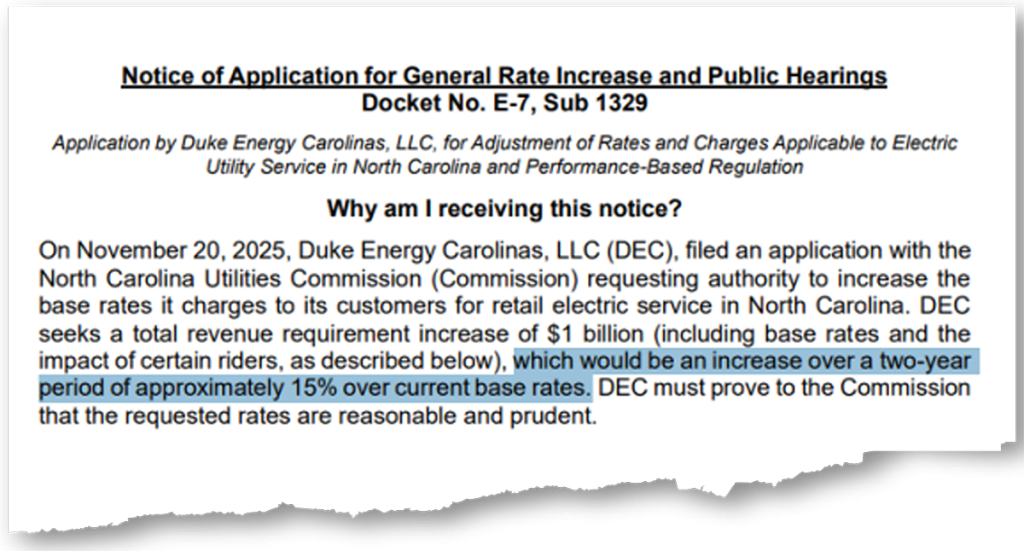
Every rate increase has to be measured against something. Duke chose to measure its proposed increase against its own projection of what it expects to collect in 2026 — a figure that factors in anticipated load growth and new customers, and is higher than what the Utilities Commission had actually authorized. Using a higher starting point makes the percentage increase look smaller.
When measured against the commission’s officially authorized baseline of $6.02 billion, Duke’s request works out to a 22% increase in 2027 and 26% by 2028, according to testimony from Edward Burgess, an energy consultant hired by the attorney general’s office. That’s nearly double what Duke advertised.
Duke says the increase reflects real costs: grid investments, coal ash basin closures, generation upgrades and transmission modernization since its last rate case in 2022. The commission must decide whether those costs justify the size of the ask.
Two watchdogs, the same verdict
Both the attorney general and the Public Staff independently concluded Duke’s request goes too far — but for different reasons.
The Public Staff — staffed by lawyers, engineers, accountants and economists — reviewed Duke’s revenue request and found it far exceeds what the evidence supports. Duke is asking for $954 million in additional revenue over the two-year plan. The Public Staff says $253 million is appropriate. That’s roughly a quarter of what Duke is seeking.
The attorney general’s team zeroed in on a different problem: Duke’s profit margin. Every regulated utility is allowed to earn a set return on its investments — money that flows to shareholders. Duke currently earns an authorized return of 10.1% and is asking the commission to raise that to 10.95%. Financial analyst Daniel Cassara, testifying for the AGO, argues the right number is 7.4% — and that approving Duke’s request would mean roughly one in every five dollars customers pay going straight to shareholders.
That concern is backed up by independent research. A recent nationwide analysis by the Economic Policy Institute found that Duke Energy Carolinas already keeps about 19 cents of every dollar customers pay as profit — ranking eighth highest among 110 investor-owned utilities nationwide, well above the industry average of roughly 13 cents per dollar.
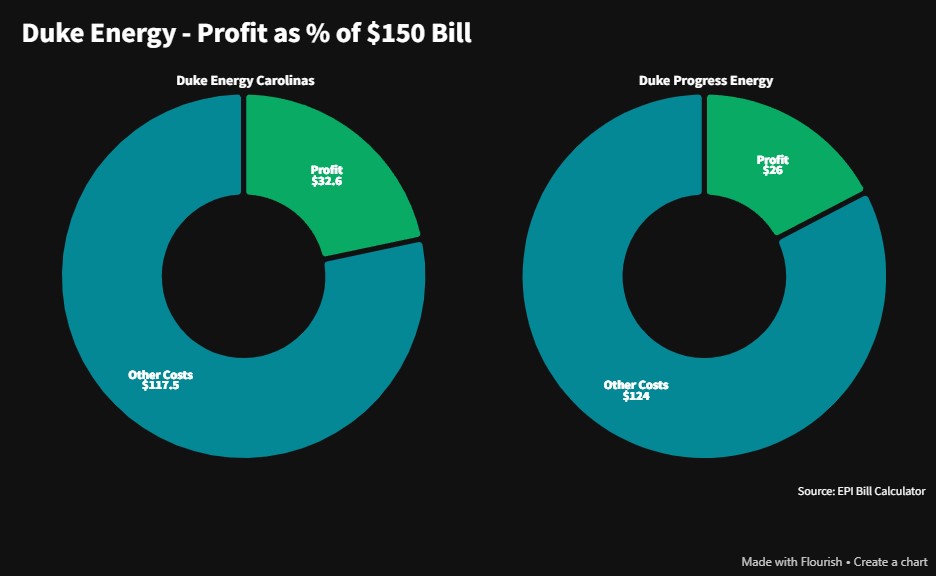
The EPI’s bill calculator puts it in starker terms: of a typical $150 monthly electric bill, roughly $32.55 goes directly to Duke Energy Carolinas as profit — a margin of 21.7%. By comparison, Duke Energy Progress, the sister utility serving other parts of North Carolina, takes $26.04 from the same $150 bill, a 17.4% margin.
Duke Energy Corporation, the parent company, reported nearly $4.9 billion in net income in 2025 — its highest on record, according to Duke Energy financial filings. Duke Energy Carolinas alone accounted for $2.1 billion of that, earning an 11.22% return on its investments — one of the highest of any utility in the country, according to testimony in the rate case. Cassara’s argument is straightforward: a company that profitable doesn’t need regulators to approve an even higher profit margin to keep investors happy.
“It strains credulity to believe that hundreds of millions of dollars in additional profits are needed to attract capital and maintain credit for one of the most profitable and well-resourced utilities in the country,”
Adopting a 7.4% return would reduce rates by $1.37 billion over the two-year period, saving the average residential customer about $435, Cassara testified.
What comes next
The Utilities Commission is expected to rule in November 2026. New rates, if approved, would take effect around Jan. 1, 2027. An expert witness hearing open to the public is set for July 7 at 10 a.m. and will stream live on YouTube.
Customers can file written comments at ncuc.gov/contactus.html using docket number E-7, Sub 1329, or testify at a public hearing. Information on how to testify is available here.
###